
Smart Shopping Cart Market Size, Share, Trends and Growth Report – Global Opportunities & Forecast, 2025-2032
Smart Shopping Cart Market Overview
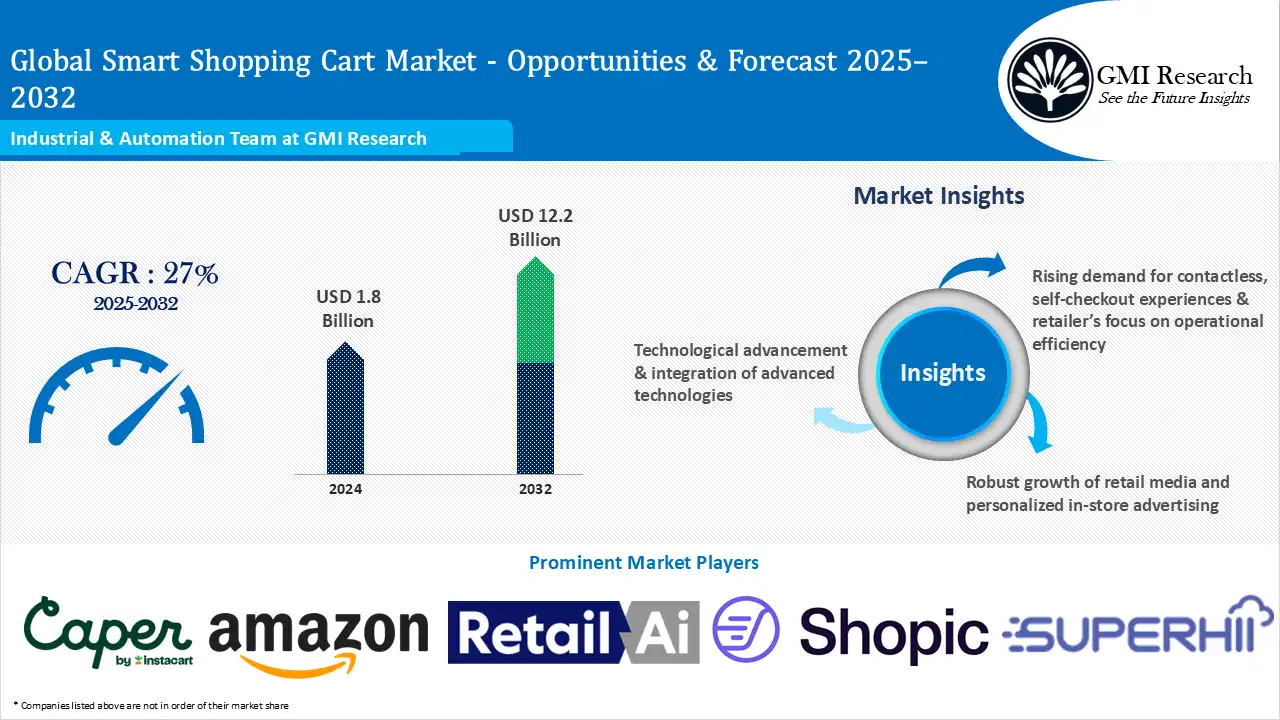
Smart Shopping Cart Market size reached USD 1.8 billion in 2024 and is estimated to reach USD 12.2 billion in 2032 and the market is estimated to grow at a very high CAGR of 27.0% from 2025-2032 driven by rising demand for contactless, self-checkout experiences & retailer’s focus on operational efficiency, robust growth of retail media and personalized in-store advertising, technological advancement & integration of advanced technologies etc.
Market Size & Forecast:
-
- 2024 – USD 1.8 Billion
- 2032 – USD 12.2 Billion
- Market Forecast – CAGR of 27% from 2025-2032
Key Segment Insights:
-
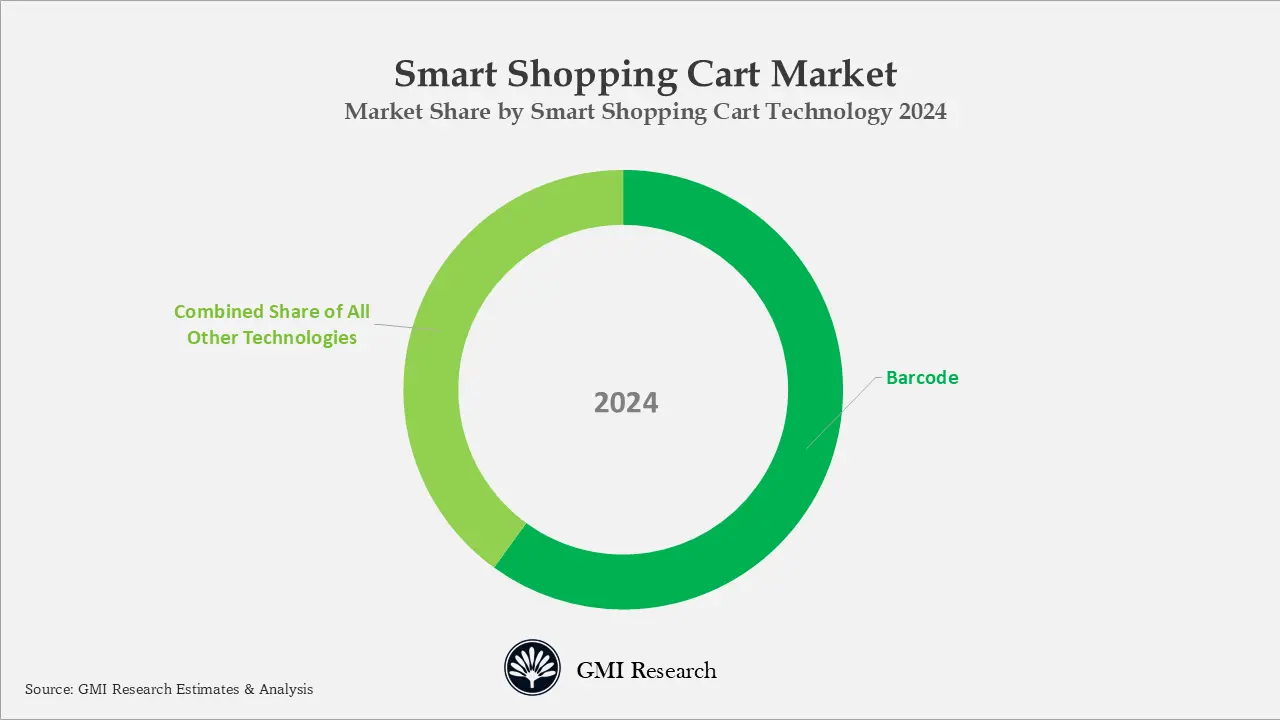
- Technology Type Insights: Bar code scanning technology hold the largest market share.
- Application Type Insights: Supermarkets account for the largest share of revenue and have largest deployment of smart shopping carts worldwide.
- Cart Type Insights: Fully integrated carts dominated the market in 2024, accounting for more than 60% of the total market share.
- Regional Insights: North America led the market in 2024, while the Asia-Pacific region is expected to experience the fastest growth over the forecast period.
Smart Shopping Cart Market Growth Drivers
Rising Demand for Contactless, Self-Checkout Experiences & Retailer’s Focus on Operational Efficiency
The widespread shortage of labour in retail sector across developed regions is paving way for the demand of smart shopping carts. Smart shopping carts are emerging as not only to address labor shortage but also it also improves customer experience. Smart carts are equipped with self-checkout functionality which enables shoppers to complete the purchases without waiting in long queues, improves overall user experience and address the major issue faced by customers in in-store shopping. Early adoption of smart shopping carts by retailers have shown improvement in operation efficiencies and improvement in customer experience.
Robust Growth of Retail Media and Personalized In-Store Advertising
The global retail media advertising spend is growing at robust growth rate and it is forecast to grow at a CAGR of 10% during the forecast period. Smart shopping carts enables retailers and brands to engage customer and shoppers at the time of purchase decision making through personalized promotions. The revenue generated from advertising on smart shopping cart is shared between the cart company and retailers using the cart. This is creating incentives for retailers to deploy smart shopping cart and to add new revenue stream is driving the demand for smart carts globally.
Technological Advancement & Integration of Advanced Technologies
Advancement of technology is supporting smart retail operations. It is benefiting both buyer and cashier as buyer can skip standing in line for billing and cashier can save the time for billing process and smoothen the workflow. Moreover, technology is used in smart shopping cart like RFID and Zigbee to identify the product details and send the information wirelessly to the receiver is driving market demand. For instance, Amazon has developed a smart shopping cart called the Amazon Dash Cart. The cart uses sensor vision algorithms and sensor fusion technology to identify the product customer place in the basket. The sensors automatically identify the cart, and the payment can be done by credit card on their Amazon account.
The RFID is projected to grow at the fastest rate in the global Smart Shopping Cart market during the forecast period. Unlike other technologies, RFID is capable of reading and writing data. RFID readers send data after reading every tag to the arduino board. It does not require line-of-sight and can read multiple tags at a time. When the shopper puts any product in the cart, it is detected by the RFID reader and displayed on LCD along with the price details of the product.
Challenges Faced by Smart Shopping Cart Market Companies
However, high initial cost of the smart shopping cart for small departmental stores will further restrict the global Smart Shopping Cart market.
Smart Shopping Cart Market Segment Analysis
Technology Type Market Insights: Bar code scanning technology hold the largest market share.
Currently bar code scanning technology dominated the global smart shopping cart deployment globally owing to its accuracy, easy to implement and lower cost compared to other technologies making them the most adorable among retailers. RFID and sensors is growing owing to increase in IoT adoptions.
Application Type Market Insights: Supermarkets account for the largest share of revenue and have largest deployment of smart shopping carts worldwide.
Based on the application, the supermarkets dominated the revenue share and have the largest deployment of smart shopping carts globally and the segment is projected to dominate the market share over the forecast period due to offering a wide range of food, beverages, and household products. Shopping malls have more footfalls than any other market owing to adopting the smart shopping cart to operate efficiently. For instance, A2Z smart technologies is producing smart carts under cust2mate with self-checkout by saving time of the of the store manager with unprecedented level of control, efficiency, and cost-effectiveness.
Cart Type Market Insights: Fully integrated carts dominated the market in 2024, accounting for more than 60% of the total market share.
Fully Integrated Carts hold the largest market share in 2024 with a market share of more than 60% as these carts provides seamless customer experience and offer significant cost operational benefits and other benefits to retailers such as improved efficiency, increased sales, and valuable data insights.
Regional Insights: North America dominated the market share in 2024, however Asia pacific is projected to grow at the fastest rate during the forecast period.
Based on the region, North America region dominated the market share due to the rising adoption of technology and increasing investments in the research and development activities along with growing start-up companies. In the US, the smart shopping cart market is highly evolving with the rising adoption of smart carts by supermarkets, hypermarkets, and other retail stores, along with the emergence of startups developing innovative smart shopping carts. Major companies such as Amazon (Whole Foods), Schnucks, Walmart are deploying smart shopping carts and many more retailers are considering to deploy smart cart in their stores. In 2026, Amazon plans to roll out its updated Dash Carts into more Whole Foods stores.
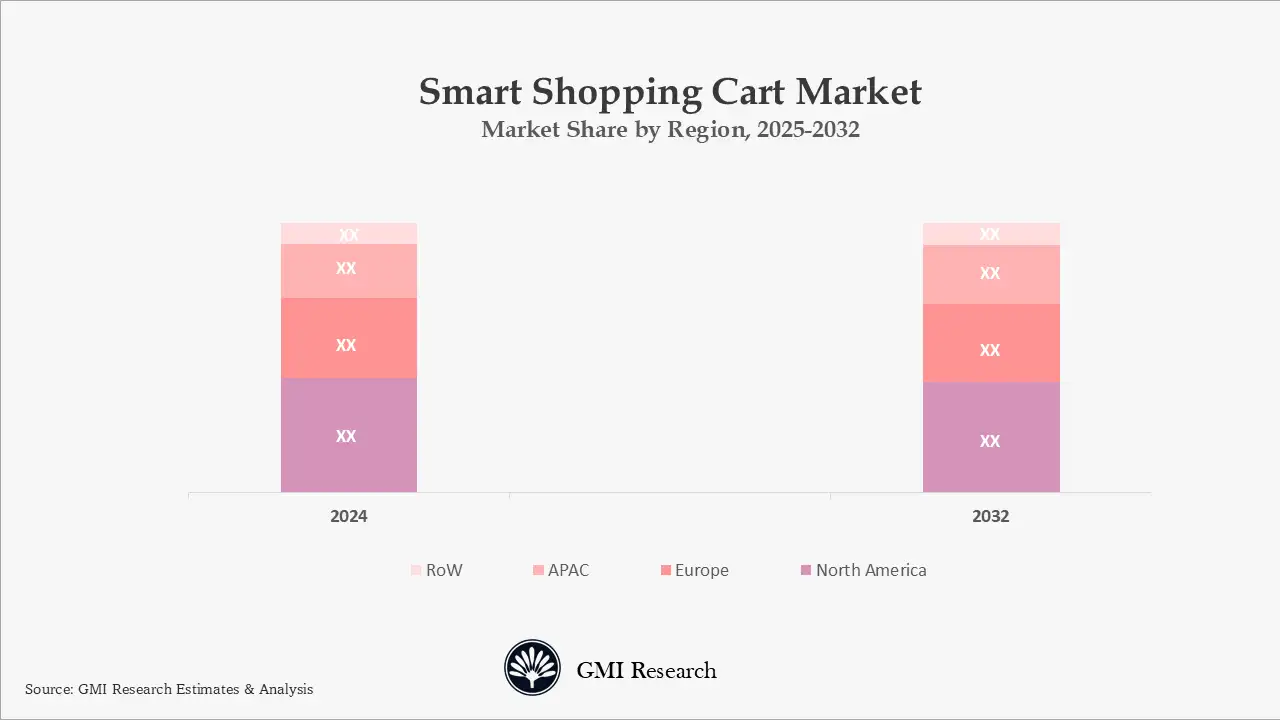
Europe stand as the second largest market for smart shopping cart globally as European retailers are focusing on improving efficiency by investing in in in-store automation and digital transformation, reduce labour cost labour shortage issues and providing seamless shopping and checkout experience to their customers. Many retailers are also piloting or rolling out smart cart solutions especially in Germany, France, the UK, and the Nordics countries.
Asia Pacific region is forecast to grow at the highest rate owing to surge in adoption of smart shopping cart by retailers especially in countries like China, Japan and South Korea. These countries have large-scale retail sectors with a large consumer base creating the potential for the penetration of the smart shopping cart in the Asia Pacific region. In China, SuperHii smart cart solutions are deployed across many retailers. In Japan, Retail AI’s smart shopping carts dominates the Japanese super markets.
Smart Shopping Cart Market Major Players & Competitive Landscape
Several leading companies are Amazon, Caper, SuperHii, Retail AI, Veeve, Shopic, Cust2Mate, Tracxpoint, Shekel, KBST, Pentland Firth Software, MetroClick, Faytech, Kwikkart, ZeroQs, Shopreme, Trollee, VasyERP, Smapca, SwiftForce and many more
Key Smart Shopping Cart Market Developments
-
- In Jan 2026, mazon to roll updated Dash Carts to more than 25 Whole Foods Market locations across the U.S., following strong customer response. The rollout includes stores in Texas, Virginia, and Massachusetts, with dozens more planned by year-end. Originally launched in Amazon Fresh stores in 2020, the updated Dash Cart is lighter, offers more capacity, and enables seamless, checkout-free shopping with automatic payment.
- In Jan 2026, A2Z Cust2Mate Solutions Corp has secured a significant $15 million smart shopping cart contract with Toys “R” Us Israel and The Red Pirate. The agreement covers the supply of 2,000 smart carts, with deployment set to begin in the third quarter of 2026. Payments will be made monthly over a five-year period. The deal is notable as it is roughly double the company’s current annual revenue of USD 7.46 million. As part of the arrangement, the retailers will use a share of the in-cart advertising space for their own promotions, while A2Z will monetize the remaining inventory through a revenue-sharing model.
- In Dec 2025, Instacart has tripled the number of stores using its Caper smart carts compared with 2024. The carts are now deployed across 100 cities in 15 states and used by more than a dozen retail banners. Nearly 20% of Wakefern Food Corp. stores, along with several national and regional grocers, have adopted the technology.
Smart Shopping Cart Market Scope of the Report
|
Report Coverage |
Details |
| Market Size Value in 2024 |
USD 1.8 billion |
| Market Revenue Forecast in 2032 |
USD 12.2 billion |
| CAGR |
27.0% |
| Market Base Year |
2024 |
| Market Forecast Period |
2025-2032 |
| Base Year & Forecast Units |
Revenues (USD Billion) |
| Market Segment | By Technology, By Application, By Mode of sales, By Cart Type, By Region |
| Regional Coverage | Asia Pacific, Europe, North America, and RoW |
| Companies Profiled | Amazon, Caper, SuperHii, Retail AI, Veeve, Shopic, Cust2Mate, Tracxpoint, Shekel, KBST, Pentland Firth Software, MetroClick, Faytech, Kwikkart, ZeroQs, Shopreme, Trollee, VasyERP, Smapca, SwiftForce, among others; a total of 20 companies covered. |
| 25% Free Customization Available | We will customize this report up to 25% as a free customization to address our client’s specific requirements |
Smart Shopping Cart Market Report Segmentation
The global Smart Shopping Cart market has been segmented on the basis of Technology, Application, Mode of sales, Cart Type and regions. Based on Technology, the market is segmented into Barcodes, RFID, and Zigbee. Based on Application, the market is segmented into Supermarket, Shopping Malls, and Others. Based on Mode of sales, the market is segmented into Direct, Distributor. Based on Cart Type, the market is segmented into Fully Integrated Carts and Retrofit.
Global Smart Shopping Cart Market by Technology
-
- Barcodes
- RFID
- Zigbee
Global Smart Shopping Cart Market by Application
-
- Supermarket
- Shopping Malls
- Others
Global Smart Shopping Cart Market by Mode of sales
-
- Direct
- Distributor
Global Smart Shopping Cart Market by Cart Type
-
- Fully Integrated Carts
- Retrofit Kits
Global Smart Shopping Cart Market by Region
-
-
North America Smart Shopping Cart Market
- US Market All-Up
- Canada Market All-Up
-
Europe Smart Shopping Cart Market
- UK Market All-Up
- Germany Market All-Up
- France Market All-Up
- Spain Market All-Up
- Rest of Europe Market All-Up
-
Asia-Pacific Smart Shopping Cart Market
- China Market All-Up
- India Market All-Up
- Japan Market All-Up
- Rest of APAC Market All-Up
-
RoW Smart Shopping Cart Market
- Brazil Market All-Up
- South Africa Market All-Up
- Saudi Arabia Market All-Up
- UAE Market All-Up
- Rest of world (remaining countries of the LAMEA region) Market All-Up
-
Major Players Operating in the Smart Shopping Cart Market
-
-
Amazon
-
Caper
-
SuperHii
-
Retail AI
-
Veeve
-
Shopic
-
Cust2Mate
-
Tracxpoint
-
Shekel
-
KBST
-
Pentland Firth Software
-
MetroClick
-
Faytech
-
Kwikkart
-
ZeroQs
-
Shopreme
-
Trollee
-
VasyERP
-
Smapca
-
SwiftForce
-
Frequently Asked Question About This Report
Smart Shopping Cart Market [UP2308-001001]
Smart Shopping Cart Market size was estimated at USD 1.8 billion in 2024
Smart Shopping Cart Market growing owing to contactless, self-checkout experiences & retailer’s focus on operational efficiency, robust growth of retail media and personalized in-store advertising, technological advancement & integration of advanced technologies etc
Smart Shopping Cart Market has huge potential for growth and the market is forecast to reach USD 12.2 billion in 2032 and the market is estimated to grow at a very high CAGR of 27.0% from 2025-2032.
Major players operating in the market are Amazon, Caper, SuperHii, Retail AI, Veeve, Shopic, Cust2Mate, Tracxpoint, Shekel, KBST, Pentland Firth Software, MetroClick, Faytech, Kwikkart, ZeroQs, Shopreme, Trollee, VasyERP, Smapca, SwiftForce and many more
North America led the market in 2024, while the Asia-Pacific region is expected to experience the fastest growth over the forecast period.
Supermarkets account for the largest share of revenue and have largest deployment of smart shopping carts worldwide.
Bar code scanning technology hold the largest market share.
Fully integrated carts dominated the market in 2024, accounting for more than 60% of the total market share.
US hold the largest market share in 2024 with large deployment.
Related Reports
Why GMI Research