
United States Cosmetic Market and Analysis Report – Opportunities and Forecast 2026-2033
US Cosmetic Market Overview
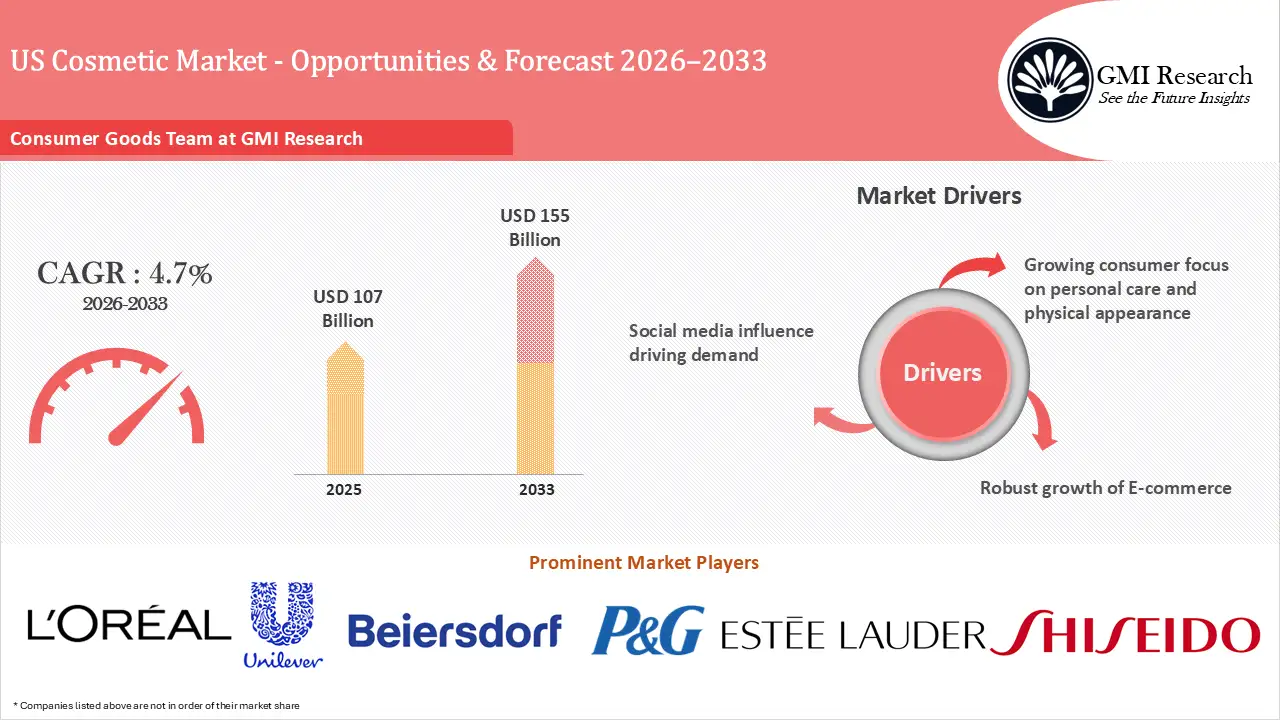
US Cosmetic Market size reached USD 107 billion in 2025 and is forecast to reach USD 155 billion in 2033, and the market is projected to grow at a CAGR of 4.7% from 2026-2033, driven by an increasing focus on personal care and physical appearance along with the e-commerce expansion and social media impact.
Market Size & Forecast:
-
- 2024 – USD 103 Billion
- 2025 – USD 107 Billion
- 2033 – USD 155 Billion
- Market Forecast – CAGR of 4.7% from 2025-2033
Key Segment Insights:
-
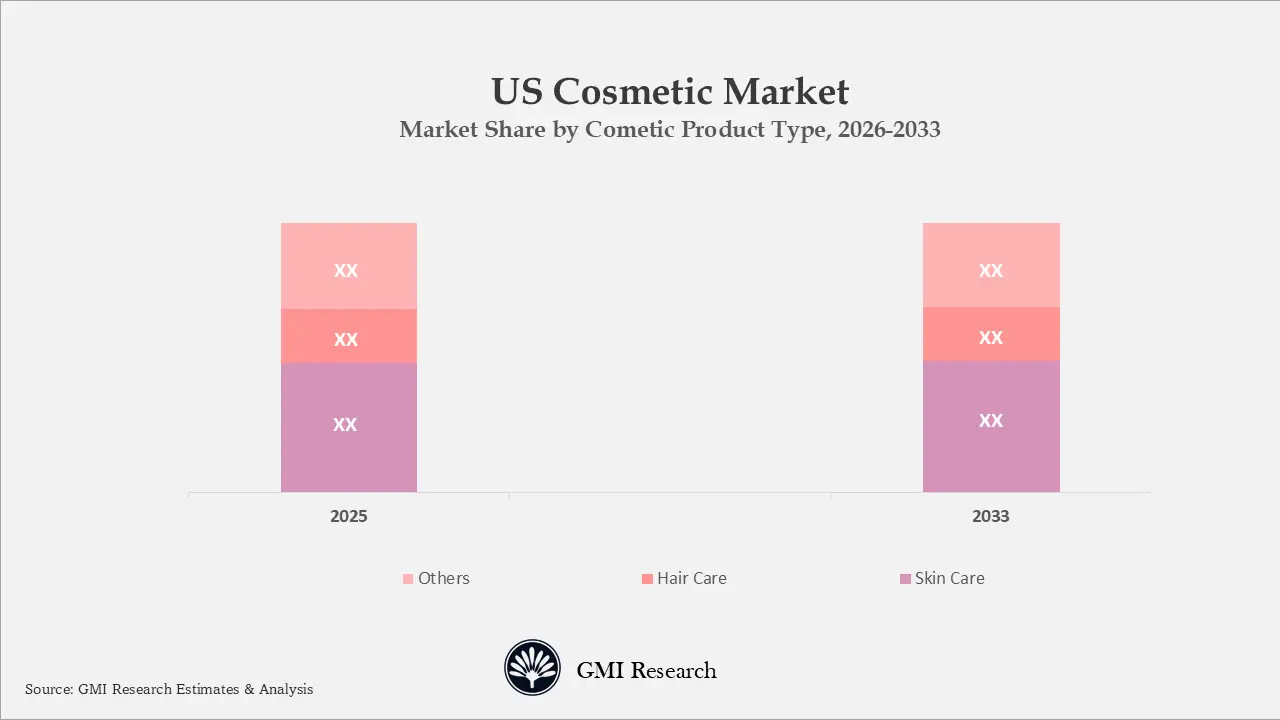
- Cosmetics Product Type Insights: Skin care dominated the US cosmetic market in 2025.
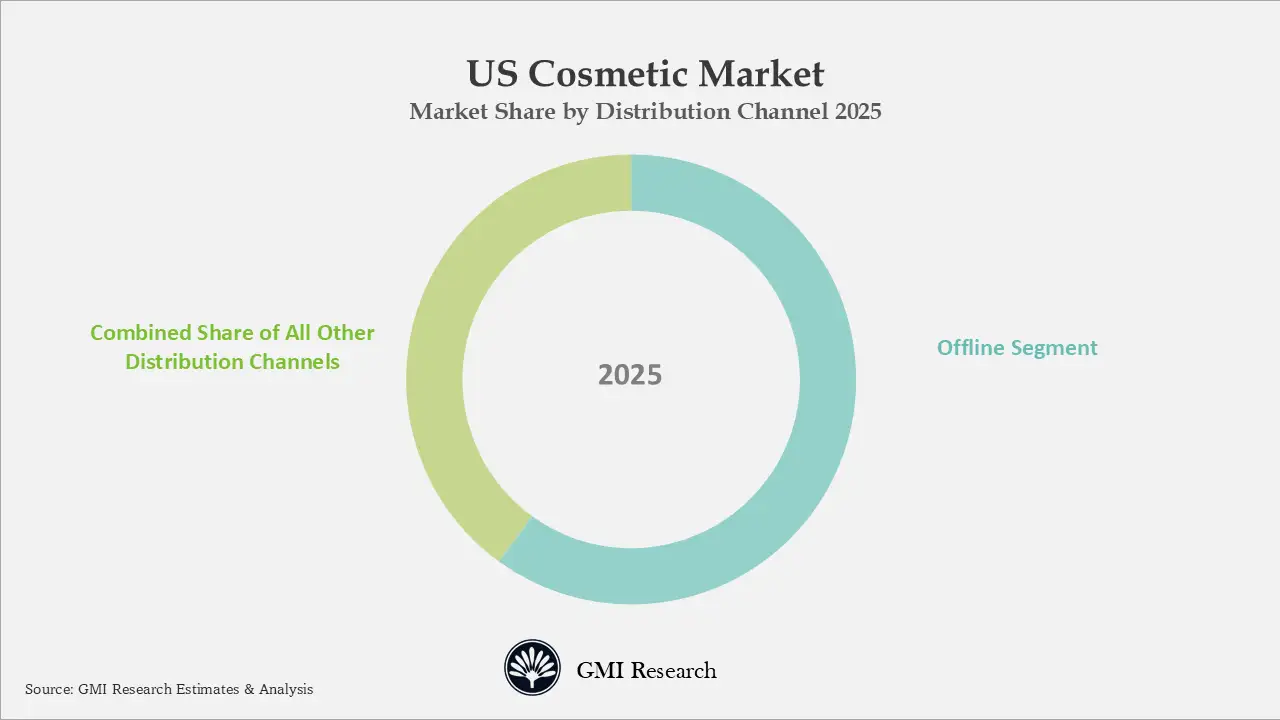
- Distribution Channels Insights: Offline segment still dominate the market with more than 50% of the total cosmetic sales.
US Cosmetic Market Trends
-
- Growing demand for clean ingredients products with natural formulations. The shift towards sustainability is driving proliferation of new cosmetics products launches with clean ingredients and eco-friendly packaging.
- Cosmetic products sales on social media platforms is growing at a robust rate and brands are adopting to these shifts in order to stay relevant and competitive in the market.
United States Cosmetics Market Growth Drivers
Growing Consumer Focus on Personal Care and Physical Appearance
Modern consumers are increasingly focused on how they look and their image in society which is driving the need for cosmetic items in the United States. The growing consumer interest in personal grooming and skincare routines is projected to propel the U.S. cosmetics market size expansion in the years ahead. Additionally, the growing appeal of skincare and cosmetics products among men has also contributed to an uptick in the need for personal care items in the US.
The cosmetics sector in the country has been dramatically changed by the younger population in recent years. The rising impact of social media on millennials’ appearance is likely to enhance the cosmetics market. Collaborations with celebrities and influencers on platforms including TikTok or Instagram will keep drawing consumer interest and increasing demand for innovative products.
Influence of Social Media
Social media and influencer marketing is playing a critical role in transforming the cosmetic industry and have reshaped the consumer shopping journey by combining discovery, research, and purchase into a single, seamless experience. According to Pew Research, Growing shares of U.S. adults say they are using Instagram, TikTok, WhatsApp and Reddit platforms, about 37% of U.S. adults use the TikTok platform, with Instagram overall adoption reaching roughly half of the adult population. Usage is significantly higher among adults under 30 compared to older age groups, highlighting a strong generational divide in platform engagement. In comparison to e-commerce in which customer search for specific products, social media commerce thrives on discovery-driven shopping stressing the role of social media for product and brand discovery.
Robust Growth of E-Commerce
The expansion of online shopping and digital marketing strategies has also greatly influenced the US skincare market in a positive way. Online sales provide convenience and access to a wider audience while focused digital marketing efforts enhance brand recognition and engage consumers. Additionally, online reviews and digital influencers play a significant role in shaping buying choices and broadening market reach. In US online sales has continue to grow at a much faster rate than in-store purchases, currently the online sales of beauty and personal care products comprises of around 40% of the total sales.
Technology Innovation
Innovative technologies have also created new US cosmetic market trends which influence the purchasing behaviours and demand patterns among young consumers and supporting market expansion. The beauty industry is undergoing a transformation with the use of AI-enhanced and personalized skincare products in the country. These innovative solutions customize treatments based on individual skin types which ensure optimal results. Its environmentally friendly formulations feature bioactive ingredients designed for long-lasting and effective skincare. The products represent a blend of innovation and personalization which offers a customized solution for achieving radiant skin.
Challenges Faced by Cosmetic Industry in US
However, US cosmetic market analysis reveals that complying with the stringent requirements set by the FDA and other regulatory agencies is a significant challenge. Companies must ensure their products adhere to safety or labelling standards which can take a lot of time and money. Meeting these regulatory requirements necessitates continual assessment of the component safety, following good manufacturing protocols, and periodic updates to align with new scientific insights or changes in laws.
US Cosmetic Market Segment Analysis
Cosmetics Product Type Market Insights: Skin care dominated the US cosmetic market in 2025
The market can be segmented according to the product type into skincare, haircare, makeup, and others with skin care leading the market. The skincare product line includes various items including serums, cleansers, and others. A key factor contributing to the growth is the brand reputation and the assumed benefits associated with using the skincare products they offer.
The US skincare products present a range of treatments designed for various skin types and concerns which features novel ingredients and exceptional formulas that meet demands for anti-aging and acne solutions. Popular brands like Neutrogena and Drunk Elephant are known for their reliable results. The skincare sector in the country is distinguished by its commitment to quality and scientific research in dermatology. Several additional factors contributing to the surge in need for skincare products which include better accessibility to branded items, the endorsement of popular figures, along with guidance based on recommendations from healthcare professionals.
Makeup and fragrance segments are also observing significant growth with the increasing regular application of makeup products like lipsticks and eyeliners, the perceived importance of fragrance as a reflection of personality along with the rising popularity of color cosmetics.
Distribution Channels Market Insights: Offline segment still dominate the market with more than 50% of the total cosmetic sales.
The offline segment is dominating the market as popular brands have emerged through traditional distribution methods which are driving a strong demand for cosmetics throughout the country. Market participants place their products in bulk on the shelves of hypermarkets, shopping malls, and specialty stores. The exposure these places provide is vital in stimulating impulse buying of different types of cosmetic products. The presence of these retail locations enables brands to connect directly with customers and give them the chance to explore their products.
Nevertheless, it is evident that brands tend to perform better and achieve higher sales when they operate in in-store and online environments. A physical retail presence is important for brands aiming to grow and increase visibility. While AI and technology are evolving rapidly in the beauty sector, nothing can replicate the opportunity to try a lipstick or sampling a fragrance in person.
Nonetheless, the online distribution channel has been creating profitable prospects for the cosmetics sector. Gen Z and millennials consumers integrate technology into their daily lives which makes it a crucial aspect and manifests in their spending behaviors or shopping choices. More customers are finding that the online cosmetics shopping experience to be completely private and are leaning towards it. Companies support these consumers by making their products available on their official websites and through various e-commerce platforms.
US Cosmetic Market Major Players & Competitive Landscape
Several leading companies operating in US cosmetic market are L’Oréal, Unilever, Estee Lauder, Procter & Gamble, Shiseido, Coty, Beiersdorf, Chanel, LVMH Moët Hennessey Louis Vuitton, Revlon, Puig and many more.
Loreal is the largest cosmetic company operating in the USA market with the highest market share and its revenues in 2024 were USD 11 billion, the company has a presence of 36 brands sold across US market reaching consumers in every category.
Major factors impacting consumer decision making are certainly product quality and product effectiveness which is further supplemented with price point, distribution channels and accessibility. Cosmetics brands are using Omni-channel to connect and reach out to customer directly from freestanding stores, to e-commerce platforms and social media platforms.
Key US Cosmetic Market Developments
-
- In Oct 2025, Unilever announced the sale of the Kate Somerville brand to Rare Beauty Brands. The Kate Somerville brand includes skincare, body care, and a clinic on Melrose Place, Los Angeles.
- In Oct 2025, Society Brands, a health and personal care e-commerce holding company, has acquired Crunchi, a direct-to-consumer clean makeup and skincare brand known for its strong network of micro-influencer advocates. With this acquisition, Society Brands expands its portfolio to 13 brands, with health and personal care accounting for 85% of its more than $160 million in annual revenue. The move also signals the company’s strategy to pursue further acquisitions targeting consumers increasingly concerned about product ingredients and overall wellness.
US Cosmetic Market Scope of the Report
|
Report Coverage |
Details |
| Market Size Value in 2025 |
USD 107 billion |
| Market Revenue Forecast in 2033 |
USD 155 billion |
| CAGR |
4.7% |
| Market Base Year |
2025 |
| Market Forecast Period |
2026-2033 |
| Base Year & Forecast Units |
Revenues (USD Billion) |
| Market Segment | By Product, By Category, By Distribution Channel |
| Regional Coverage | United States |
| Companies Profiled | L’Oréal, Unilever, Estee Lauder, Procter & Gamble, Shiseido, Coty, Beiersdorf, Chanel, LVMH Moët Hennessey Louis Vuitton, Revlon, Puig , among others; a total of 11 companies covered. |
| 25% Free Customization Available | We will customize this report up to 25% as a free customization to address our client’s specific requirements |
US Cosmetic Market Research Report Segmentation
The United States Cosmetic Market has been segmented on the basis of product, Category and distribution channel. Based on the product, the market is segmented into skin care, hair care, makeup, fragrance, others. Based on the Category, the market is segmented into Mass and Luxury. Based on the distribution channel, the market is segmented into offline, online.
United States Cosmetic Market by Product
-
- Skin Care
- Hair Care
- Makeup
- Fragrance
- Others
United States Cosmetic Market by Category
-
- Mass
- Luxury
United States Cosmetic Market by Distribution Channel
-
- Offline
- Online
United States Cosmetic Market Leading players
-
-
L’Oréal
-
Unilever
-
Estée Lauder Companies
-
Procter & Gamble
-
Shiseido
-
Coty
-
Beiersdorf
-
Chanel
-
LVMH Moët Hennessy Louis Vuitton
-
Revlon
-
Puig
-
Frequently Asked Question About This Report
United States Cosmetic Market [GR24AB-01-00340]
US Cosmetics Market size was estimated at USD XX billion in 2025
US cosmetic market growth is driven by growing consumer focus on personal care and physical appearance, influence of social media, robust growth of e-commerce and technology innovation
US cosmetic market has the potential for growth
Major cosmetic companies dominating the market are L’Oréal, Unilever, Estee Lauder, Procter & Gamble, Shiseido, Coty, Beiersdorf, Chanel, LVMH Moët Hennessey Louis Vuitton, Revlon, Puig and many more.
Skin care dominated the US cosmetic market in 2025 owing to consumers growing emphasis on maintaining healthy skin. rising demand for anti-aging solutions, hydration, skin barrier repair, and dermatologist-recommended products.
Offline segment continues to dominate USA cosmetics market, accounting for over 50% of total sales, supported by strong consumer trust, in-store product evaluation opportunities, and well-established distribution networks. Meanwhile, online channels are experiencing the fastest growth and are expected to be a key driver of market expansion throughout the forecast period.
Related Reports
Why GMI Research