
Unmanned Aerial Vehicle Market Size, Share, Trends and Growth Report – Global Opportunities & Forecast, 2026-2033
Unmanned Aerial Vehicle Market Overview
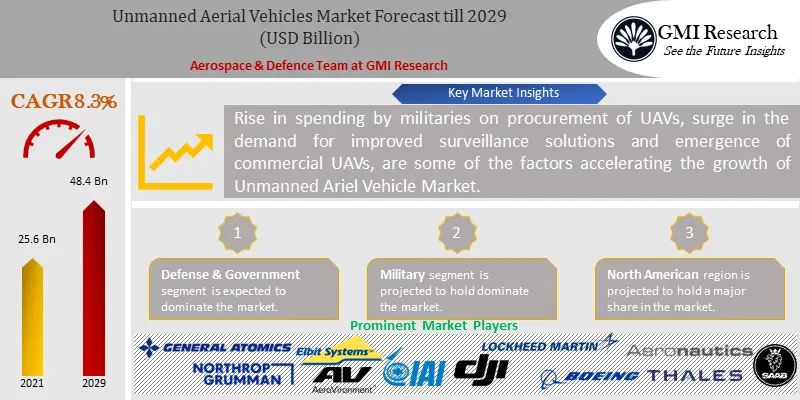
Unmanned Aerial Vehicle Market Size was valued at USD 28.9 billion in 2025 and is forecast to touch USD 53.9 billion in 2033, and the market is expected to grow at a CAGR of 8.1% from 2026-2033 primarily driven by rising defense & security spending, growing usage of UAV by military, expanding commercial applications, growth in logistics & last-mile delivery.
Market Size & Forecast:
-
- 2025 – USD 28.9 Billion
- 2033 – USD 53.9 Billion
- Market Forecast – CAGR of 8.1% from 2026-2033
Key Segment Insights:
-
- UAV Type Insights: Fixed-wing UAVs dominate global demand and are projected to grow at a steady pace.
- Mode of Operation Type Insights: Remotely piloted UAVs hold the largest share in terms of revenue.
- Applications Insights: The commercial segment is anticipated to register the fastest growth over the forecast period.
- End-Use Industry Insights: The defense & security segment is expected to account for the largest market share in 2025.
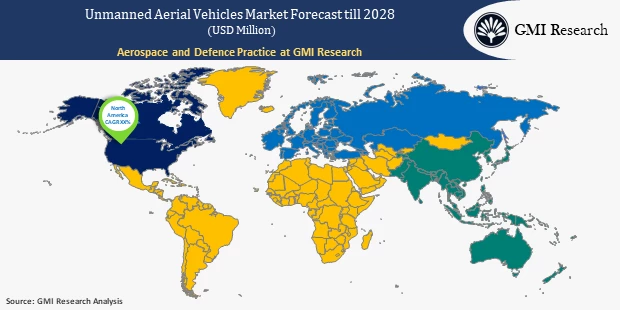
- Regional Insights : North America is projected to lead the market, capturing 39% share in 2025.
Unmanned Aerial Vehicle Market Growth Drivers
Rising Defense & Security Spending
Global military spending has climbed to historic highs in recent years, driven by notable increases across Europe and the Middle East. Heightened geopolitical tensions, particularly involving the U.S., Israel, and Iran, are expected to further accelerate defense budget growth in the near term. According to Stockholm International Peace Research Institute, worldwide defense expenditure reached USD 2.7 trillion in 2024, reflecting a 9.4% year-on-year rise, with all regions recording increased military spending. US, China, Russia, Germany and India together accounted for around 60% of the total global spending in 2024. Majority of the countries are spending on drone technology to make themselves prepare for the future of warfare. In June 2025, Donald J. Trump signed the “Unleashing American Drone Dominance” executive order to strengthen U.S. drone capabilities across commercial and military sectors, including plans to supply large volumes of low-cost, domestically produced drones to enhance military combat effectiveness.
Growing Usage of UAV by Military
Unmanned Aerial Vehicle Market is primarily driven by increasing spending by militaries on procurement of UAVs, growing demand for improved surveillance solutions Demand for drones is increasing rapidly in military applications. With changing geopolitical landscape, many countries are focussing to add more drones in their militaries to strengthen their armed forces, which will create lucrative opportunities for defense manufacturers to expand their business in coming years.
Due to recent usage of drone in Ukraine & Russia War and US, Israel & Iran war drones have proven their worth and currently the drone technology is rapidly reshaping modern warfare, with countries worldwide investing heavily in unmanned aerial vehicles (UAVs) for surveillance, combat operations, and intelligence gathering. Growing Demand for persistent, real-time battlefield awareness Intelligence, Surveillance, and Reconnaissance (ISR) also driving the demand for UAV globally. Some of the major countries investing in drone technologies are US, China, and Russia are leading investments in advanced and AI-driven drones, including swarm technologies. Israel remains a pioneer in drone innovation and exports, while India is scaling up procurement, domestic production, and troop training. Countries like Iran rely on low-cost drones for asymmetric warfare, and Ukraine’s battlefield experience has accelerated global adoption. Overall, drones are becoming central to military strategy due to their cost-effectiveness, precision, and ability to reshape traditional combat dynamics.
Expanding Commercial Applications
The UAV industry is rapidly expanding, with increasing adoption and technological advancements. Commercial drones (UAVs) are advanced unmanned systems used across industries such as logistics, agriculture, construction, public safety, and infrastructure inspection, improving efficiency, precision, and safety in tasks that are labor-intensive or hazardous. Their applications include surveying, mapping, crop monitoring, search and rescue, environmental tracking, and last-mile delivery.
In construction, drones enhance project efficiency, reduce costs, and improve tracking these benefits are driving UAV market demand in construction industry, while in renewable energy they support inspection and maintenance of assets like wind turbines and solar panels. Agriculture is a key adoption area, where drones enable precision farming, boost productivity, and help address challenges such as climate change and pollution. Overall, drones are transforming industries by improving operational efficiency and reducing costs. The robust growth in the construction sector is driving UAV global demand.
Challenges Faced by Unmanned Aerial Vehicle Market Companies
Regulatory challenges remain the primary barrier to global UAV market growth, driven by complex and evolving rules around BVLOS operations, stringent airspace integration requirements, and increasing data privacy concerns.
Unmanned Aerial Vehicle Market Segment Analysis
UAV Class Type Market Insights:
Smaller drones typically under 2 kg see higher units sales than larger models, largely because they are more cost-effective, compact and portable, off the shelf, user-friendly, and face fewer regulatory limitations. The strong demand for smaller drones comes from consumers, hobbyists, and beginners fuels higher sales of accessible, user-friendly devices.
Medium-sized drones are primarily used in commercial sectors such as energy, construction, agriculture, and transport. Although unit sales are lower due to higher costs, the commercial segment is more lucrative than the recreational market. These drones typically range from mid-sized models for inspection and mapping to heavy-lift systems for logistics, spraying, and specialized industrial applications and also for military missions.
Large drones are primarily built for military and defense roles, including surveillance and strike missions, often featuring MALE and HALE drone systems capabilities. Medium drones (150–600 kg) are also mainly military-focused, while large drones exceeding 600 kg are exclusively used in defense. These systems operate beyond visual range and support ISR, combat, and targeted operations.
UAV Type Market Insights: Fixed-Wing UAV market dominates the global UAV demand and is forecast to grow at a considerable CAGR.
Fixed-wing drones consume less power since lift is generated by their wings, allowing them to travel faster and cover longer distances with heavier payloads. Built like airplanes, they are currently the fastest type of military UAV in operation.
Vertical Take-Off and Landing fixed wing UAVs are gaining traction in the market as it provides improved endurance, can fly in high distances and offers more coverage as compared to multirotor UAVs. In addition, increasing use of these UAVs in application such as farming, infrastructure inspection and surveillance activities, is propelling the segment’s growth.
Mode of Operation Type Market Insights: Remotely piloted type UAV’s accounted for the largest market revenues.
Most UAVs are equipped with remote control systems that allow operators to prevent crashes and safely navigate them away from hazards. In military Remotely piloted UAVs are very popular and are widely used in military operations due to their cost-effectiveness, reduced risk, and ability to deliver advanced intelligence and precision strike capabilities.
UAV/ Drone Applications Market Insights: Commercial segment is projected to grow at the highest rate during the forecast period
The commercial segment is expected to register the fastest growth during the forecast period owing to demand for mapping, surveying, delivery and spraying etc. Although the number of commercial UAVs units sold are small compare to recreational drones but due to the higher price of the commercial UAV, this segment accounted for a significant revenue share.
Military drones captures a significant market share and is projected to grow at a robust CAGR rat during the forecast period. As per NATO, In the Ukraine conflict, NATO-classified Class I (<150 kg) and Class III (>600 kg) drones have been deployed, with small drones widely used for surveillance, target acquisition, battle damage assessment, and information warfare. Even Russia is also using a modified version of Gernan-2 a version of Shahed-131 weighing around 150 Kg for long range attacks and Lancet drone for attack on armoured vehicles etc.
Class III drones or large drones are designed for long-endurance surveillance and remote strikes, these drones can operate for extended periods but are highly vulnerable without air superiority. These drones are proved costly and susceptible to air defenses and electronic warfare, leading to heavy losses and reduced effectiveness, with some systems also facing reliability issues in delivering accurate intelligence. This has been observed in Ukraine Russia war where Turkish Bayraktar TB2, initially it was very successful but when Russian brough in air defences and electronic warfare these drones become vulnerable. The same we have seen in a war with US and Houthis, despite of Houthis having very old and outdated air defense systems they managed to shoot down tens of US MQ-9 Reaper drones, the same is witnessed in US & Israel and Iran war.
UAV End-Use Industry Market Insights: Defense & Security captures the largest market share in 2025.
Defense & Security industry hold the largest revenue share and the demand for UAVs from defence & security industry is projected to grow at a robust rate owing to the effectiveness of drones in recent wars. The new era of warfare is centred around drones and defence departments across countries are investing heavily in various types of ISR and combat drones.
Construction industry generates the largest revenues for drones industry in commercial sector followed by the energy sector. The construction industry is rapidly adopting commercial drones, emerging as one of the largest markets. In construction, drones are widely used for surveying, inspections, mapping, and precise measurements, with adoption expected to grow further as technology advances.
Logistics & Transportation industry is forecast to grow at the highest rate during the forecast period. Drone deliveries are rapidly transforming retail and logistics, particularly in last-mile delivery. They enable faster, cost-effective, and eco-friendly transport of medicines, groceries, and parcels are driving drone delivery market growth. Major players like Amazon, UPS, DHL, and Walmart are adopting this technology, alongside specialists such as Wing, Zipline, and Matternet.
Regional Market Insights: North America region captures the largest market share of 39% in 2025.
North American Unmanned Ariel Vehicles Market is the largest globally with a market share if 39% in 2025 and is majorly driven by growing adoption of drones for defense and commercial applications and increasing focus of companies on developing cost-effective drones. US being the pioneer in using drones in military has a large drone manufacturing base with large companies such as General Atomics, Northrop Grumman Corporation and many more.
UAV market in Asia Pacific growth is forecast to grow at the fastest rate owing to increase in military spending in innovations in drone technologies across major countries especially by China, Japan, India. Rising geopolitical tensions especially in the East Asia has led to increase in defence spending. Growing use of UAVs in agriculture and real-estate sectors is further driving the regional UAV market.
Europe region is also forecast to grow at a healthy rate during the forecast period owing to increase defence spending. Pressure from the U.S. on European NATO members to raise defense spending from an initial 2% to potentially 5% of GDP by 2035 is boosting demand for military equipment across the region especially UAV. The European Union is accelerating drone development and countermeasures through coordinated funding and initiatives such as the European Defence Fund and Permanent Structured Cooperation. Following the 2022 Versailles commitment, member states are increasing defense spending and investing in advanced technologies, including drones. The ReArm Europe / Readiness 2030 plan, led by Ursula von der Leyen, aims to strengthen defense capabilities with over €800 billion in funding, encouraging higher national spending. key initiative is the Eurodrone, developed by Airbus Defence and Space, Leonardo, and Dassault Aviation, and managed by OCCAR. Supported by France, Germany, Spain, and Italy, the program focuses on ISR capabilities and reducing reliance on non-EU systems, backed by significant EU funding.
Unmanned Aerial Systems (UAS) Market Major Players & Competitive Landscape
Several leading companies are General Atomics, Northrop Grumman Corporation, BAE Systems, Elbit Systems, Baykar, Israel Aerospace Industries, AeroVironment, Teledyne Technologies, Lockheed Martin, Boeing Company, Aeronautics, Saab SE, Thales Groups, Yuneec, and SZ DJI Technology Co., Ltd., AVIC (Chengdu) UAS Co., Ltd and many more.
Key Unmanned Aerial Vehicle Market Developments
-
- In March 2026, China’s AVIC signed a USD 5 billion agreement with GAMI to establish a Wing Loong-3 UAV assembly line in Jeddah, producing 48 drones annually. The deal reflects a shift toward strategic defense collaboration in the Middle East, supported by the UAV’s proven combat performance, rapid targeting capabilities, and enhanced anti-jamming systems.
- In Dec 2025, GKN Aerospace and Anduril Industries UK have partnered to develop next-generation UAV and rotorcraft solutions for UK defense programs. The collaboration focuses on advanced aerostructures, integration systems, and flight testing, targeting upcoming contracts while strengthening the UK’s sovereign defense capabilities.
- In Dec 2025, AeroVironment has secured an USD 874 million, five-year IDIQ contract from the U.S. Army Contracting Command to supply UAS and counter-UAS systems to allied forces through foreign military sales. The contract includes multiple drone platforms including specific variations of the JUMP 20™, P550™, Puma™, Raven™, and Titan C-UAS™ systems, along with training, spare parts, and logistics support.
- In June 2025, Ukraine plans to produce 2.5 million drones, supported by USD 2.5 billion in contracts with 76 companies. The Ministry of Defense is investing over USD 2.5 billion in 2024–2025 to boost domestic production, engaging 500+ suppliers to strengthen its drone manufacturing ecosystem.
Key Unmanned Aerial Vehicle Market outlook
The outlook for global unmanned aerial vehicle market looks promising and as per the GMI Research the unmanned aerial vehicle size in 2025 reached USD 28.9 billion and the market is projected to touch USD 53.9 billion in 2033. The market is projected to grow owing to robust spending in defense across the major countries owing to global uncertainty coupled with expanding use of drone for commercially across industry.
Unmanned Aerial Vehicle Market Scope of the Report
|
Report Coverage |
Details |
| Market Size Value in 2025 |
USD 28.9 billion |
| Market Revenue Forecast in 2033 |
USD 53.9 billion |
| CAGR |
8.1% |
| Market Base Year |
2025 |
| Market Forecast Period |
2026-2033 |
| Base Year & Forecast Units |
Revenues (USD Million) |
| Market Segment | By UAV Class, By Type, By Mode of Operation, By Application, By Industry, By Region |
| Regional Coverage | Asia Pacific, Europe, North America, and RoW |
| Companies Profiled | General Atomics, Northrop Grumman Corporation, BAE Systems, Elbit Systems, Baykar, Israel Aerospace Industries, AeroVironment, Teledyne Technologies, Lockheed Martin, Boeing Company, Aeronautics, Saab SE, Thales Groups, Yuneec, and SZ DJI Technology Co., Ltd., AVIC (Chengdu) UAS Co., Ltd among others; a total of 16 companies covered. |
| 25% Free Customization Available | We will customize this report up to 25% as a free customization to address our client’s specific requirements |
Unmanned Aerial Vehicle Market Research Report Segmentation
The Global Unmanned Aerial Vehicles (UAV) Market has been segmented on the basis of UAV Class, Type, Mode of Operation, Application, Industry and Region. Based on the UAV Class, the market is segmented into <20 KG, 20–150 KG, 150–600 KG, and >600 KG. Based on the Type, the market is segmented into Fixed Wing, Rotary Wing, and Hybrid Wing. Based on the Mode of Operation, the market is segmented into Remotely Piloted, Optionally Piloted, and Fully Autonomous. Based on the Application, the market is segmented into Military & Law Enforcement, Commercial, and Consumer/Recreational. Based on the Industry, the market is segmented into Defense & Security, Construction & Mining, Agriculture, Forestry & Wildlife Conservation, Logistics & Transportation, Energy & Power, Media & Entertainment, Insurance, and Others.
Global Unmanned Aerial Vehicles (UAV) Market by UAV Class
-
- <20 KG
- 20-150 KG
- 150-600 KG
- >600 KG
Global Unmanned Aerial Vehicles (UAV) Market by Type
-
- Fixed Wing
- Rotary Wing
- Hybrid Wing
Global Unmanned Aerial Vehicles (UAV) Market by Mode of Operation
-
- Remotely Piloted
- Optionally Piloted
- Fully Autonomous
Global Unmanned Aerial Vehicles (UAV) Market by Application
-
- Military & Law Enforcement
- Commercial
- Consumer/Recreational
Global Unmanned Aerial Vehicles (UAV) Market by Industry
-
- Defense & Security
- Construction & Mining
- Agriculture, Forestry & Wild Life Conservation
- Logistics & Transportation
- Energy & Power
- Media & Entertainment
- Insurance
- Others
Global Unmanned Aerial Vehicle (UAV) Market by Region
-
-
North America Unmanned Aerial Vehicle Market
- US Market
- Canada Market
-
Europe Unmanned Aerial Vehicle Market
- UK Market
- Germany Market
- France Market
- Spain Market
- Rest of Europe Market
-
Asia-Pacific Unmanned Aerial Vehicle Market
- China Market
- India Market
- Japan Market
- Rest of APAC Market
-
RoW Unmanned Aerial Vehicle Market
- Brazil Market
- South Africa Market
- Saudi Arabia Market
- UAE Market
- Rest of world (remaining countries of the LAMEA region) Market
-
Major Players Operating the Unmanned Aerial Vehicle (UAV) Market
-
-
General Atomics
-
Northrop Grumman Corporation
-
BAE Systems
-
Elbit Systems
-
Baykar
-
Israel Aerospace Industries
-
AeroVironment
-
Teledyne Technologies
-
Lockheed Martin
-
Boeing Company
-
Aeronautics
-
Saab AB
-
Thales Group
-
Yuneec
-
SZ DJI Technology Co., Ltd.
-
AVIC (Chengdu) UAS Co., Ltd.
-
Frequently Asked Question About This Report
Unmanned Aerial Vehicle Market [UP692A-00-0620]
Unmanned Aerial Vehicle Market size was estimated at USD 28.9 billion in 2025
Unmanned Aerial Vehicles Market is growing due to rising defense & security spending, growing usage of UAV by military, expanding commercial applications, growth in logistics & last-mile delivery.
Unmanned Aerial Vehicle Market has significant growth potential and the market is forecast to touch USD 53.9 billion in 2033, and the market is expected to grow at a CAGR of 8.1% from 2026-2033.
Major UAV players globally are General Atomics, Northrop Grumman Corporation, Elbit Systems, Israel Aerospace Industries, AeroVironment, Teledyne Technologies, Lockheed Martin, Boeing Company, Aeronautics, Saab SE, Thales Groups, Yuneec, and SZ DJI Technology Co., Ltd., AVIC (Chengdu) UAS Co., Ltd and many more.
North America is projected to lead the market, capturing 39% share in 2025 followed by Asia pacific and Europe.
Fixed-wing UAVs dominate global demand and are projected to grow at a steady pace.
Remotely piloted UAVs hold the largest share in terms of revenue.
The commercial segment is anticipated to register the fastest growth over the forecast period.
The defense & security segment is expected to account for the largest market share in 2025.
US dominates the global UAV market globally with a substantial market share in 2025.
Related Reports
Why GMI Research