
Saudi Arabia Defense Market and Analysis Report – Opportunities and Forecast 2026-2033
Saudi Arabia Defense Market Overview
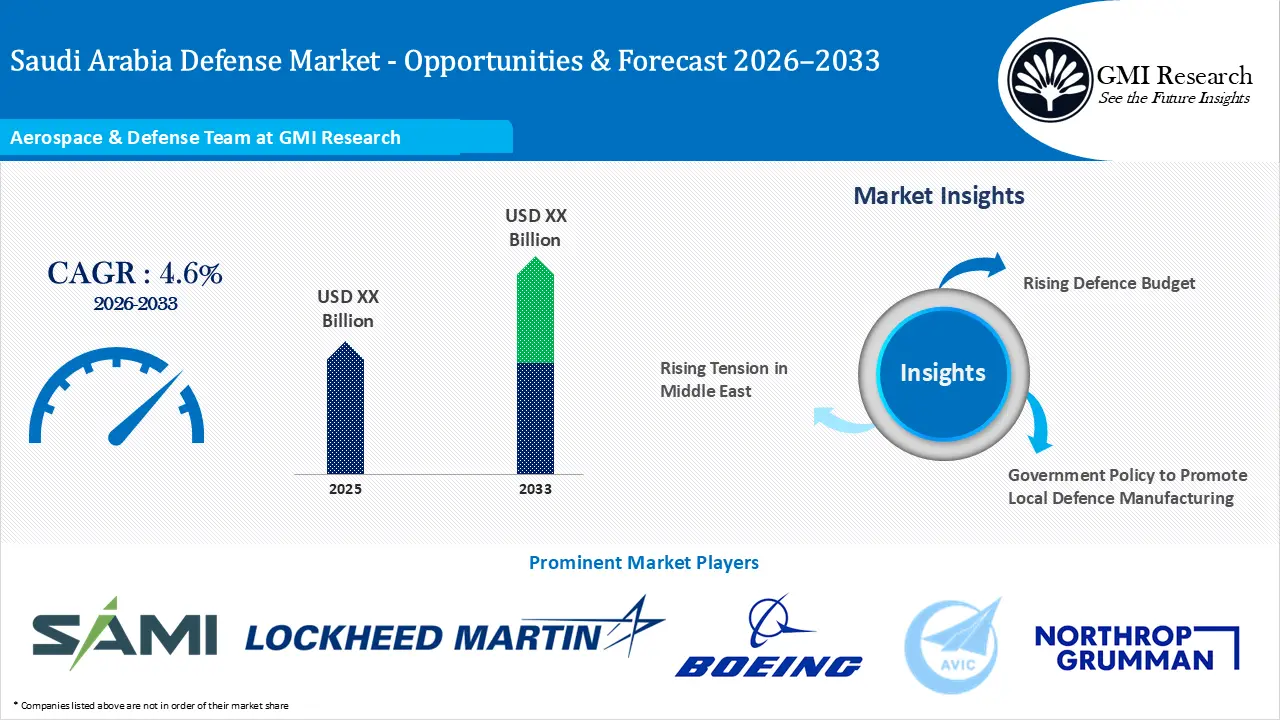
Saudi Arabia Defense Market size is projected to grow at robust CAGR of 4.6% between 2026 and 2033 owing to rising defence budget, escalating tension in Middle East and government policy to promote local defence manufacturing.
Market Size & Forecast:
-
- Market Forecast – CAGR of 4.8% from 2026-2033
- 2025 – USD XX Billion
- 2033 – USD XX Billion
Saudi Arabia Defense Market Growth Drivers
Rising Defence Budget
As per the Ministry of Finance, the military expenditure of Saudi Arabia was estimated at USD 63.7 billion in 2025 an increase of 1.1% over 2024, making Saudi Arabia the largest country in terms of defence spending in the Middle East. As per Sipri, Saudi Arabia is also amongst the leading global arms importers and ranked 3rd globally after Ukraine and India between 2021 and 2025. KSA’s defence spending stood at 7.3% of the country GDP in 2024 and it is among the highest in the world only after Ukraine, Israel, and Algeria. The US is the largest supplier to KSA for 77% of the total arms imports.
Rising Tension in Middle East
The US Israel attack on Iran has changed the security structure in Middle East when Iran attacked the GCC countries US bases and infrastructure. This war is expected to change the security structure in the region with regional countries are expected to diversify their defence alliances. This is expected to change the defence alliance structure within the region as countries in the region will look to diversify the defence alliances. The defense budget of Saudi Arabia is projected to rise in the coming years due to the new realities of the region to be more ready and prepared for future warfare. Its is expected the KSA will develop new defense partnership which creates enormous opportunities for the defence companies.
Government Policy to Promote Local Defence Manufacturing
Saudi Arabia’s pursuit of localizing defense manufacturing has seen substantial progress in the present period, although the initiatives to establish a homegrown military industry trace back to the mid-1960s. Faced with the challenge of lacking an improved technological industrial base and a skilled national workforce, Riyadh implemented offset programs as a strategic approach to drive indigenous military industrialization. Offset programs serve as a type of countertrade, focusing on alleviating the economic impact of procurement deals by mandating international contractors to invest in the importing country’s economy. In Saudi Arabia, these programs are predominantly aimed at technology transfers and training for local workers. Despite only allocating 2% of military spending to indigenous defense firms in 2017, Saudi Arabia has been functioning to advance its localization targets by restructuring the domestic defense landscape and refitting its business approach to the military sector.
Moreover, as part of the Vision 2030 economic diversification program, Saudi Arabia targets the localization of 50% of its military procurement by 2030. This endeavor is overseen by two key military-industrial entities. The General Authority for Military Industries and Saudi Arabian Military Industries play a direct contracting role with foreign companies positioning a strategic move toward accomplishing greater self-sufficiency in the country’s defense industry. SAMI’s CEO, Walid Abukhaled, has consistently articulated the company’s ambition to rank among the top 25 defense companies by 2030. He highlights the role of foreign partnerships and joint ventures as crucial pathways for the rapid growth of SAMI and the wider Saudi local defense industry. Despite prevailing legislation in Saudi Arabia addressing defense procurement, in practice, much of it is formalized and is typically settled on a case-by-case basis.
In 2019, GAMI introduced the Industrial Participation Program (IPP), succeeding Saudi Arabia’s Economic Offset Program. The IPP is designed to improve the local military industries sector by expanding into value-added segments. Its objectives include establishing a network of services and technical support, propelling strategic partnerships with international companies, facilitating technology transfer, helping SMEs participate in the local supply chain, and developing a pool of trained professionals for precise industries. GAMI is strategically concentrating its localization endeavors on land-based systems, considering their relatively easier production and flexibility in alignment with cash flow dynamics, GAMI places special stress on the robust need for aircraft parts. Key projects outlined in the Ministry of Finance’s 2023 budget include facility construction at the King Salman Airbase, relocation, and establishment of the King Faisal Air Academy, and the upgrading of the National Guard Ministry.
Saudi Defense Industry Major Players & Competitive Landscape
Several leading companies are operating in the market include Saudi Arabian Military Industries (SAMI), Lockheed Martin Corporation, The Boeing Company, BAE Systems PLC, AVIC (Chengdu) UAS Co., Ltd , Raytheon Technologies Corporation, Northrop Grumman Corporation, General Dynamics Corporation, Leonardo SpA, Airbus SE, Almaz-Antei Corporation JSC among others.
In the FY26 budget the government set an objective for the completion of the project to update the military industry sector strategy, aimed at achieving the strategic objective of localizing 50% of defense spending by 2030 is expected to provide significant opportunities for defence companies who are interested in technology transfer and interested in setting up plants to produce in KSA.
Saudi Arabia offers a range of cash and non-cash incentives such as government lobbying support, favorable financing, subsidized resources, and beneficial tax and trade structures to attract investment and strengthen the global competitiveness of its defense sector.
Key Saudi Arabia Defense Market Developments
-
- In 16 July, 2026, United States has approved a potential USD 1.96 billion arms sale to Saudi Arabia, including up to 20,000 Advanced Precision Kill Weapon System (APKWS-II) guidance sections for air-to-air and air-to-ground operations. The deal aims to strengthen Saudi Arabia’s homeland defense, enhance interoperability with U.S. and allied forces, and improve regional security. BAE Systems will serve as the principal contractor, supported by U.S. government and contractor personnel for training and maintenance.
- In March 2026, GAMI signed a $5 billion agreement with AVIC to set up a Wing Loong-3 UAV assembly line in Jeddah, with an annual output of 48 drones. The deal highlights a shift toward deeper strategic defense collaboration in the Middle East, backed by the UAV’s demonstrated combat effectiveness, rapid targeting, and improved anti-jamming capabilities.
- In Jan 2026, the U.S. government approved Saudi Arabia’s request for 730 Patriot PAC-3 MSE missiles produced by Lockheed Martin, with the total package including support equipment valued at approximately USD 9.0 billion.
- In Feb 2024, Saudi Arabia’s Ministry of Defense signed 19 contracts and two MoUs at World Defense Show 2024 to enhance military readiness, strengthen capabilities, and support localization under Vision 2030. Key agreements include deals with LIG Nex1 for air defense system localization, Raytheon Technologies, Middle East Propulsion Company, SAAB, Haji Husein Ali Reza & Co. Ltd, Thales, Saudi Arabian Military Industries, Big Blue Pearl Company, Modern Technology Company, and Saudi Information Technology Company. Additionally, MoUs were signed with Lockheed Martin and Raytheon Defense Company to support future air defense system requirements.
Key Saudi Arabia Defense Market outlook
In light of the current geopolitical issues in Middle east and KSA government’s push for local defence equipment manufacturing the Saudi Arabia defense market is forecast to grow at a robust CAGR of 4.8% between 2026 and 2033. Saudi Arabia may reassess its traditional US-led security dependence and gradually diversifying its defence partnerships amid rising regional tensions with Iran. While strong ties with the US remain, Riyadh is expanding cooperation with China, Pakistan, and Turkey as part of a broader “look East” strategy. This includes deeper engagement with China beyond procurement, such as technology transfers, drone manufacturing, and missile development, alongside strengthened regional defence collaboration. In 2926, Saudi-China defense ties have advanced from basic arms purchases to technology transfer, highlighted by a USD 5 billion deal to build a Wing Loong-3 drone assembly line in Jeddah and reported Chinese support for Saudi ballistic missile production.
Saudi Arabia Defense Market Scope of the Report
|
Report Coverage |
Details |
| Market Revenues (2025) |
USD Million |
| CAGR |
4.6% |
| Market Base Year |
2025 |
| Market Forecast Period |
2026-2033 |
| Base Year & Forecast Units |
Revenues (USD Million) |
| Market Segment | By Platform, By Procurement Source |
| Regional Coverage | Saudi Arabia |
| Companies Profiled | Saudi Arabian Military Industries (SAMI), Lockheed Martin Corporation, The Boeing Company, BAE Systems PLC, AVIC (Chengdu) UAS Co., Ltd , Raytheon Technologies Corporation, Northrop Grumman Corporation, General Dynamics Corporation, Leonardo SpA, Airbus SE, Almaz-Antei Corporation JSC among others; a total of 10 companies covered. |
| 25% Free Customization Available | We will customize this report up to 25% as a free customization to address our client’s specific requirements |
Saudi Arabia Defense Market Research Report Segmentation
Saudi Arabia Defense Market report is segmentation into platforms and procurement source. By Platform the market is segmented into Land Based Systems (Main Battle Tanks, Armored vehicles, Artillery, Others), Air Based Systems (Fighter Jets, UAVs, Transport Aircraft, Helicopters, Specialized Aircrafts), Naval Systems (Surface Ships, Submarines, Unmanned Maritime Systems), Space Based Systems (Satellites, ISR, Navigation, Missiles Warning Systems), C4ISR and Electronic Warfare. By Procurement Source the market is segmented into Dometic and Import.
Saudi Arabia Defense Market by Platform
-
- Land-Based Systems
- Main battle tanks
- Armored vehicles
- Artillery
- Others
- Air-Based Systems
- Fighter Jets
- UAVs
- Transport Aircraft
- Helicopters
- Specialized Aircraft
- Others
- Naval Systems
- Surface ships
- Submarines
- Unmanned Maritime Systems
- Others
- Space-Based Systems
- Satellites
- ISR
- Navigation
- Missile Warning Systems
- C4ISR and Electronic Warfare
- Land-Based Systems
Saudi Arabia Defense Market by Procurement Source
-
- Dometic
- Import
Saudi Arabia Defense Leading Market Players
-
-
Saudi Arabian Military Industries (SAMI)
-
Lockheed Martin Corporation
-
The Boeing Company
-
BAE Systems plc
-
AVIC (Chengdu) UAS Co., Ltd.
-
Raytheon Technologies Corporation
-
Northrop Grumman Corporation
-
General Dynamics Corporation
-
Leonardo S.p.A.
-
Airbus SE
-
Almaz- Antei Corporation JSC
-
Frequently Asked Question About This Report
Saudi Arabia Defense Market [GR24AB-01-00259]
Saudi Arabia Defense Market size was estimated at USD XX billion in 2025
Saudi Arabia defense market is growing owing to rising defence budget, escalating tension in Middle East and government policy to promote local defence manufacturing.
Saudi Arabia Defense Market has significant growth potential and the market is forecast to grow at a robust CAGR of 4.6% from 2026-2033.
Major defense companies operating in KSA market are Saudi Arabian Military Industries (SAMI), Lockheed Martin Corporation, The Boeing Company, BAE Systems PLC, AVIC (Chengdu) UAS Co., Ltd , Raytheon Technologies Corporation, Northrop Grumman Corporation, General Dynamics Corporation, Leonardo SpA, Airbus SE, Almaz-Antei Corporation JSC among others.
Related Reports
Why GMI Research