
Indonesia Plastic Market and Analysis Report – Opportunities and Forecast 2026-2033
Indonesia Plastic Market Overview
Indonesia Plastics Market size was estimated at 8.6 million tons in 2025 and the market is forecast to reach 13.2 million tons in 2033 growing at a steady CAGR of 5.5% between 2026 and 2033 owing to the increasing demand for plastic across various industries along with the rapid urbanization and industrialization.
Market Size & Forecast:
-
- 2025 – 8.6 Million Tons
- 2033 – 13.2 Million Tons
- Market Forecast – CAGR of 5.5% from 2026-2033
Key Segment Insights:
-
- Plastic Type Insights: Polyethylene (PE) plastic type hold the largest market share in 2025.
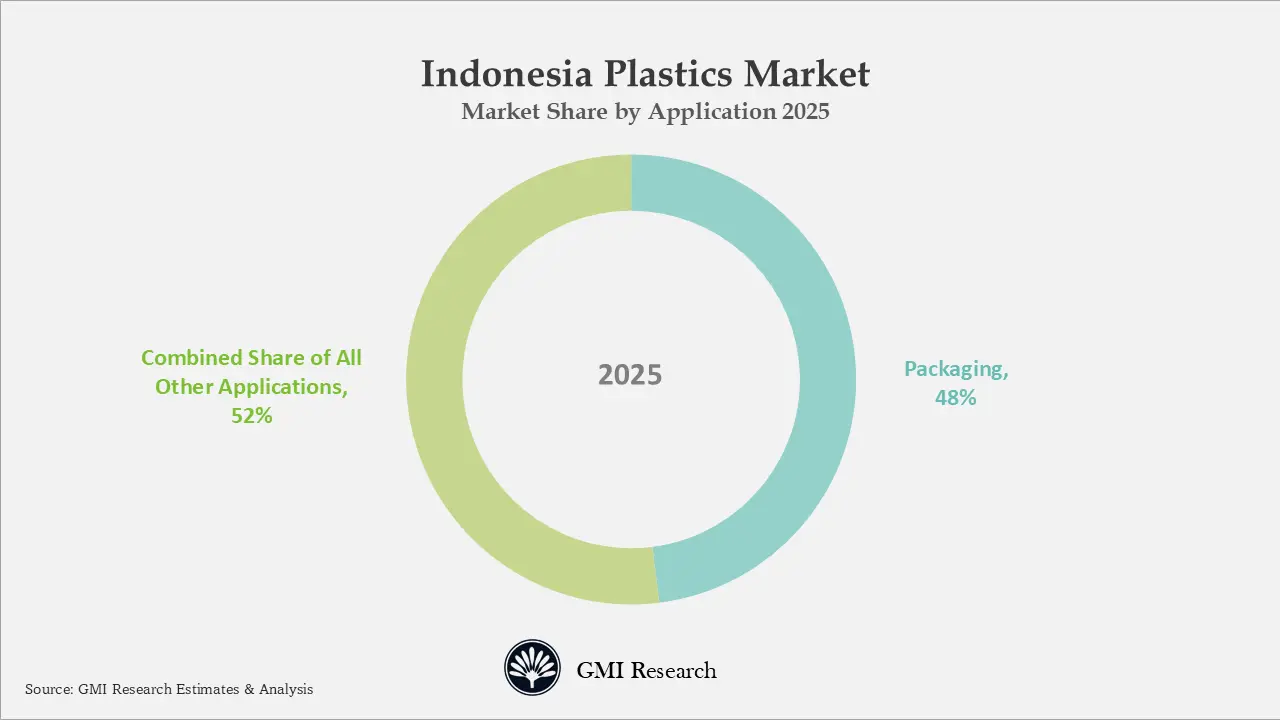
- Application Insights: Packaging application segment accounted for the largest market share of 48% in 2025.
The plastic market growth in Indonesia is attributed to steady economic expansion and increased demand across various sectors spanning from packaging to construction. The surge in industrial growth is boosting the consumption of plastic items in Indonesia, a trend bolstered by the rapid urbanization. With a burgeoning urban population, there is a surging demand for plastics especially in packaging, infrastructure projects, and consumer goods. The packaging sector is particularly a key user of plastics driven by the growth in e-commerce platforms and modern retail methods. The preference for plastics, particularly in flexible packaging, is driven by their cost-effectiveness and ability to protect products effectively which are critical in influencing the dynamics of plastic industry. Plastic materials are essential for urban development, extensively employed in building materials and piping systems.
As per the report Plastics and Rubber Asia on Indonesia plastics market notes that the local government has introduced a policy requiring 70% of plastic products to be domestically produced, opening significant prospects for skill development, machinery suppliers, and raw material exporters. As per the Indonesian Olefin, Aromatic, and Plastic Association (INAplas) on their Indonesia plastics market research report, annual plastic consumption per capita in the country is relatively low, at just more than 17 kilograms, in contrast to about 35 kilograms in Malaysia, 40 kilograms in Singapore and Thailand, and approximately 100 kilograms in Western Europe. It emphasizes substantial growth opportunities as Indonesia’s consumption-driven economy benefits from increasing personal incomes. Domestic production meets a considerable portion of the total demand, while the remaining material is imported. Other than the food and beverage sector which dominates plastic consumption in Indonesia, the agricultural, construction, automotive, and electronic industries also play substantial roles as major purchasers of plastics.

Indonesia Plastic Market Growth Drivers
Rapid urbanization and industrialization
Population growth coupled with rapid urbanization is driving demand for plastic in Indonesia. Indonesia being the fourth most populous country in the world with a huge population of 277 million and sizeable middle class population has become an attractive consumer market driving demand for goods in the country. The robust growth of food & beverages sectors which is growing between 5% to 7% is fueling demand for plastic packaging.
The Indonesia GDP continued its growth momentum in 2025 and expanded by 5.11% in 2025, grew slightly over 5.03% growth recorded a year earlier. Household final consumption expenditure remained solid driving demand for food, beverages, personal care, automotive etc. This strong GDP growth leading to solid household consumption is driving the demand for plastic demand in the country.
Increasing demand for plastic across various industries
In the packaging industry, plastics are essential for driving market growth because of their chemical resistance and outstanding wear, recyclability, ease of molding, and strong mechanical properties. Plastics dominate industries such as food retailing and healthcare sector due to their lightweight nature and ability to protect against moisture, positioning them as superior choices to other materials. In Indonesia, polyethylene terephthalate or PET is preferred material of choice for its exceptional qualities in packaging applications especially in food packing, because of its excellent attributes such as low risks of handling, minimal toxicity, and lack of BPA or heavy metals which ensures stringent safety standards.
As per Indonesian Packaging Federation (FPI), the plastic packaging sector in Indonesia to grow between 3-4% in 2024. The transition from traditional to modern retail outlets such as convenience stores and supermarkets has generated increased demand for packaging in consumer goods, with food and beverage sectors alone contributing to nearly 70% of overall plastics usage. The FPI reports that plastic rigid and flexible packaging make up over half of the total demand, fueled by rising packaging needs in the domestic food and pharmaceutical packaging.
Additionally, the country’s’ manufacturing sector is experiencing robust growth particularly in areas like electronics and automotive, leveraging plastic components extensively across applications ranging from electronic enclosures to automotive parts. The growing middle class in Indonesia and shifting consumer preferences underscore the plastics’ critical role in fostering innovation and satisfying heightened demand for a wide range of consumer goods, from essential household goods to electronic products. Furthermore, significant investments from local and international entities in the plastic industry are accelerating technological innovations, boosting production capacities, and expanding the variety of plastics products available in the market.
Indonesia’s burgeoning automotive industry is growing at a steady rate and the in 2024 the total vehicle production reached 1.2 million units according to Gaikindo. According to Plastics European an average car containing between 150-200 kilograms of plastics which is around 15% of the car’s total weight, the Indonesian government goals to achieve 2 million new cars sales annually by 2030 is projected to generate massive demand for plastics during the forecast period.
Are you Looking for a Partner for your Indonesia Market Entry and Business Expansion plans? GMI Research with decades of experience tracking Indonesia market is the right choice for you.
Challenges Faced by Indonesia Plastic Industry
However, Indonesia plastic market is navigating challenges posed by stringent governmental policies regarding the use of plastics and a significant dependency on raw material imports. The enforcement of regulations banning one-time-use plastic and restricting their packaging has compelled domestic and global manufacturers to review their operations. Despite its ecological importance, this legislative framework poses logistical complexities that companies must overcome to achieve compliance while balancing financial management.
Furthermore, a significant reliance on outsourced resources increases vulnerabilities which makes markets susceptible to fluctuations caused by disruptions in the supply chain or unpredictable global price changes. To tackle these challenges, stakeholders must prioritize developing sustainable and innovative solutions, investing in domestic capabilities, boosting production efficiency, engaging policymakers, and collectively shaping legislation that balances ecological priorities with economic sustainability. The market landscape has shifted significantly due to the adoption of restrictions on single-use plastics, alongside directives promoting effective waste management and bolstering recycling efforts. An integrated action plan was deployed to achieve a 70 percent reduction in plastic pollution in oceans by 2025, with a broader objective of eliminating plastic waste entirely by transitioning to circular economy strategies by 2040.
Indonesia Plastic Market Segment Analysis
Plastic Type Market Insights: Polyethylene (PE) plastic type hold the largest market share in 2025
Polyethylene (PE) being the most widely used plastic types across packaging applications, dominated the Indonesia plastic industry in 2024 driven by its to its ability to be produced in various densities.
Polypropylene is an ideal material type in applications such as food packaging and storage especially for food items which needs to be heated is growing to owing to burgeoning food & beverage industry. The push for lighter cars to improve fuel efficiency is driving its demand from the automotive industry as Polypropylene offer significant weight reduction compared to steel.
The beverages industry in Indonesia which is growing at a CAGR of 4.8% between 2025-2032 is driving demand for PET in the country. PET stands out when it comes to beverages packaging due to its features such as highly resistant to chemicals, strength and easy to recycle.
Application Market Insights: Packaging application segment accounted for the largest market share of 48% in 2025
Packaging segments dominated the plastic market as most of the products consumers purchase are packed in plastic material to ensure the product safety during the transportation. Indonesia’s packaging industry is dominated by plastic and packaging remains the major application of plastics. The demand for plastic in packaging is further fuelled by solid household final consumption expenditure which is driving plastic packaging demand from booming e-commerce sector, rapid urbanization, shift towards packaged foods etc. Packaging and construction are the two dominant applications for plastics in Indonesia.
Indonesia Plastic Market Major Players & Competitive Landscape
Major players operating in Indonesia plastic industry are Chandra Asri Petrochemical, PT Pertamina Petrochemical Trading, Polytama Propindo, Lotte Chemical Titan, Asahimas Chemical, and Polychem Indonesia, Lotte Chemical Titan, PT. Indo-Rama Synthetics, Dow, BASF, Mitsui, Indonesia Nanya Indah Plastics and many more.
Indonesia Plastic Market Scope of the Report
|
Report Coverage |
Details |
| Market Size Value in 2025 |
8.6 million tons |
| Market Revenue Forecast in 2033 |
13.2 million tons |
| CAGR |
5.5% |
| Market Base Year |
2025 |
| Market Forecast Period |
2026-2033 |
| Base Year & Forecast Units |
Revenues (USD Million) |
| Market Segment | By Type, By End-Use Industry |
| Regional Coverage | Indonesia |
| Companies Profiled | Chandra Asri Petrochemical, PT Pertamina Petrochemical Trading, Polytama Propindo, Lotte Chemical Titan, Asahimas Chemical, and Polychem Indonesia, Lotte Chemical Titan, PT. Indo-Rama Synthetics, Dow, BASF, Mitsui, Indonesia Nanya Indah Plastics among others; a total of 11 companies covered. |
| 25% Free Customization Available | We will customize this report up to 25% as a free customization to address our client’s specific requirements |
Indonesia Plastic Market Research Report Segmentation
The Indonesia Plastic Market has been segmented on the basis of type and end-use industry. Based on the type, the market is segmented into polypropylene, polyethylene, polyvinyl chloride, polyethylene terephthalate, polycarbonate, polyamide, polystyrene, polyurethane and others. Based on the end-use industry, the market is segmented into automotive & transportation, packaging, consumer goods, infrastructure & construction, healthcare & pharmaceuticals, electrical & electronics, others.
Indonesia Plastic Market by Type
-
- Polyethylene
- Polypropylene
- Polyethylene Terephthalate
- Polyvinyl Chloride
- Polyamide
- Polycarbonate
- Polyurethane
- Polystyrene
- Others
Indonesia Plastic Market by End-Use Industry
-
- Packaging
- Automotive & Transportation
- Infrastructure & Construction
- Consumer Goods
- Healthcare & Pharmaceuticals
- Electrical & Electronics
- Others
Indonesia Plastics Market Leading players
-
-
Chandra Asri Petrochemical
-
PT Pertamina Petrochemical Trading
-
Polytama Propindo
-
Lotte Chemical Titan
-
Asahimas Chemical
-
Polychem Indonesia
-
PT Indo-Rama Synthetics Tbk
-
Dow
-
BASF
-
Mitsui & Co.
-
Indonesia Nanya Indah Plastics
-
Frequently Asked Question About This Report
Indonesia Plastic Market [GR24AB-01-00278]
Indonesia Plastic Market size was estimated at 8.6 million Tons in 2025.
Indonesia Plastics Market growth is driven by growing demand for plastic across various industries coupled with the rapid urbanization and industrialization.
Indonesia Plastics Market future outlook is bright and it looks poised for sustained growth, the market is forecast to reach 13.2 million tons in 2033 growing at a steady CAGR of 5.5% between 2026 and 2033.
Several leading companies are Chandra Asri Petrochemical, PT Pertamina Petrochemical Trading, Polytama Propindo, Lotte Chemical Titan, Asahimas Chemical, and Polychem Indonesia, Lotte Chemical Titan, PT. Indo-Rama Synthetics, Dow, BASF, Mitsui, Indonesia Nanya Indah Plastics and many more.
Packaging application segment accounted for the largest market share of 48% in 2025.
Polyethylene (PE) plastic type hold the largest market share in 2025.
Related Reports
Why GMI Research