
Smart Home Market and Analysis Report – Opportunities and Forecast 2026-2033
Smart Home Market Overview
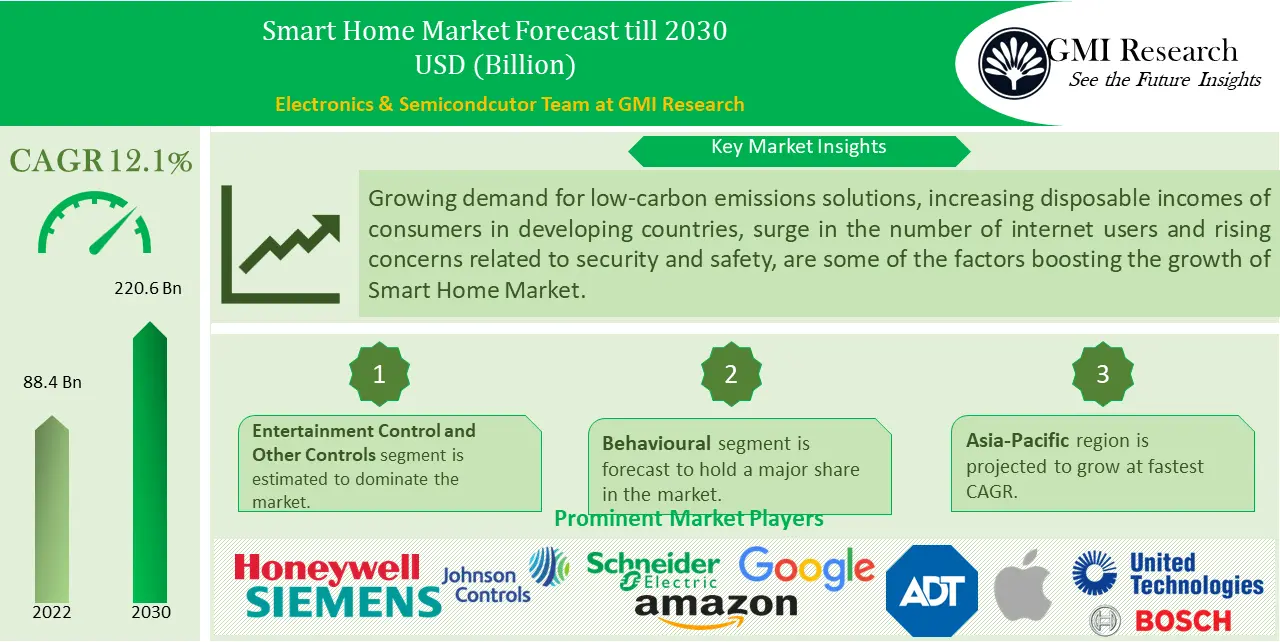
Smart Home Market size reached a value of USD 152.3 billion in 2025 and the smart home market forecast to touch USD 356.1 billion in 2033 growing at a CAGR of 11.2% between 2025 and 2033.The market is being shaped by several converging drivers including the widespread adoption of IoT and connected devices, growing consumer demand for intelligent home automation, and an increasing focus on energy efficiency. Complementing these are the rapid rollout of 5G and high-speed broadband, rising home security and safety concerns, and the seamless integration of artificial intelligence and voice assistant technologies.
Market Size & Forecast:
-
- 2025 – USD 142.3 Billion
- 2033 – USD 356.1 Billion
- Market Forecast – CAGR of 11.2% from 2026-2033
Key Segment Insights:
-
- Device Type Insights: Smart entertainment systems, including video entertainment devices and smart speakers, accounted for the largest share of the smart home market in 2025.
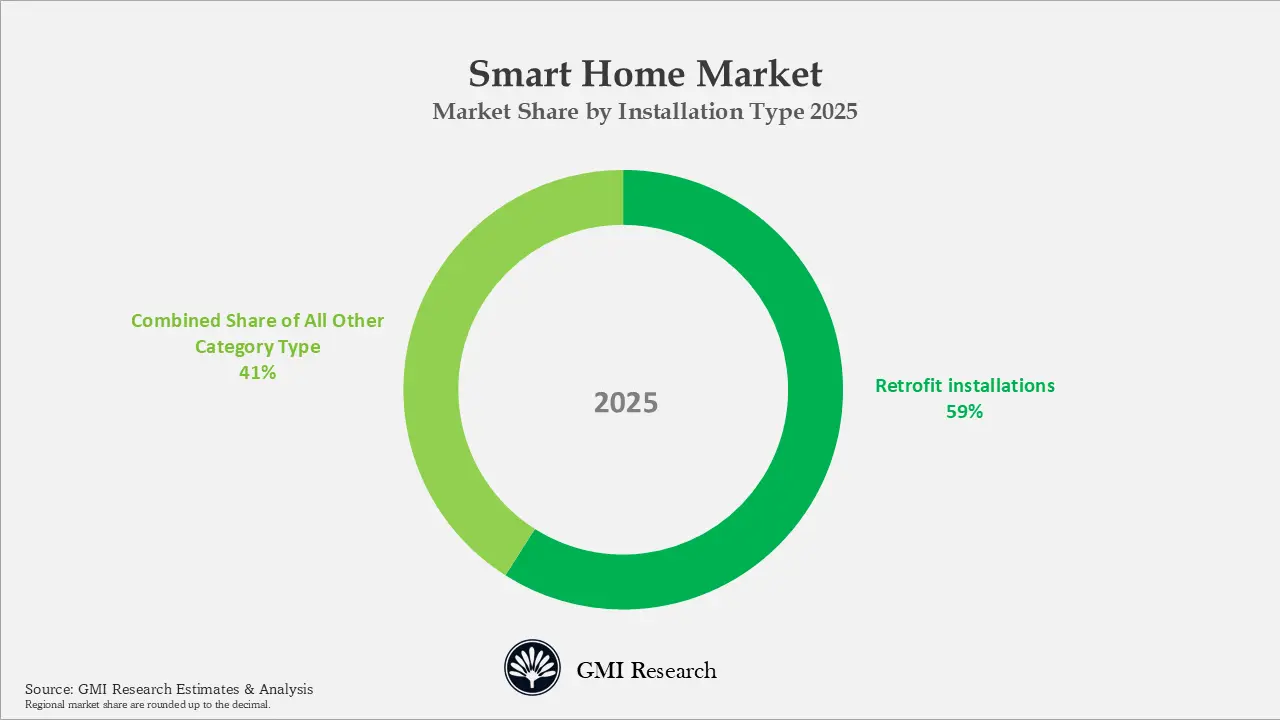
- Installation Type Insights: Retrofit installations dominated the market, capturing 59% of the total market share in 2025.
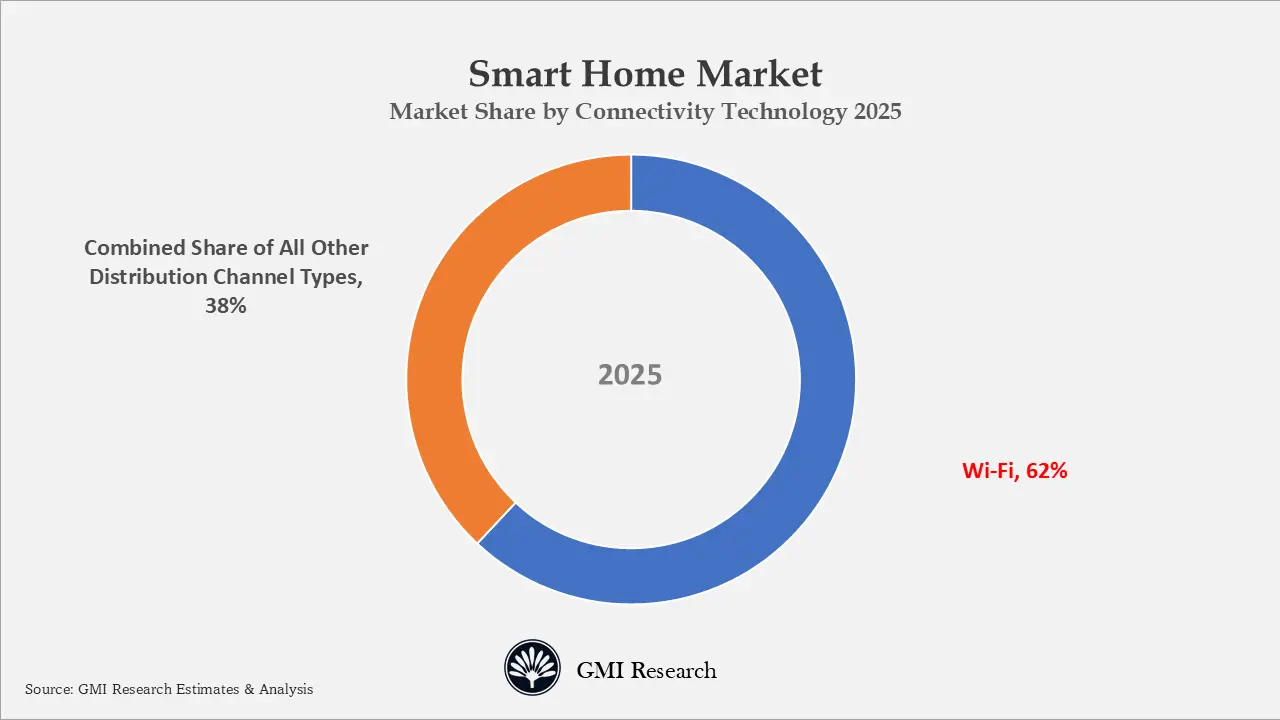
- Connectivity Technology Insights: Wi-Fi remained the leading connectivity technology, accounting for 62% of the market share in 2025.
Regional Insights:
-
- The North America smart home market was valued at USD 54.1 billion in 2025 and is projected to expand at a CAGR of 7.8% during 2026–2033.
- USA has the highest penetration of smart home devices in homes globally, the county captures a market share of 87% of the market share in 2025 valuing USD 47 billion.
- Asia-Pacific Smart Home Market is forecast to grow at the fastest rate of 16.1% between 2026 and 2033
- Europe smart home market was valued at USD 46.1 billion in 2025 and it is projected to attain a CAGR of 8.6% between 2026 and 2033
Smart Home Market Trends
-
- The smart home market is shifting from standalone devices to integrated ecosystems, driving greater interoperability among connected devices through cloud platforms, smartphone applications, and web-based services for seamless automation and centralized control.
- Rising cybersecurity and reliability requirements are encouraging the adoption of IP-based connectivity, robust authentication protocols, and over-the-air software and firmware updates to ensure the secure and efficient operation of smart home systems.

Smart Home Market Growth Drivers
Growing Security and Safety Concerns
Smart homes feature integrated monitoring systems that enable users to control electrical and security devices through a single interface. Convenience, safety, and security are key factors driving the growth of the smart home devices market. Smart home solutions are gaining traction among consumers due to their ability to save time in performing household tasks while providing room-by-room surveillance and intrusion alerts, even when users are in remote locations. Additionally, the increasing penetration of the internet and smartphones worldwide is expected to accelerate the adoption of smartphone-connected smart home devices in the coming years. With increasing internet adoption rates coupled with deployment of 5G technology, this figure will surpass 1 billion in coming few years, which will boost the demand for smartphones-home connected devices in the country.
Integration of Artificial Intelligence and Voice Assistants
The integration of artificial intelligence with digital assistants such as Siri, Google Assistant, Alexa enhances the user experience by enabling smart home devices to be controlled and managed through voice commands. Additionally, the expanding capabilities of digital assistants, including hands-free channel surfing and Bluetooth speaker control, are supporting the growth of the smart home appliances market. Increasing investments in new product development, rising adoption of technologies such as blockchain and smart speech recognition, and the integration of lighting controllers with built-in data connectivity are further driving market growth. However, smart home solutions collect personal consumer data, including medical information, movement patterns, and purchase history, making data privacy and security important considerations.
Increasing Focus on Energy Efficiency
Growing demand for energy efficiency and sustainability is a major driver of the smart home market. Homes are significant consumers of global energy, making the reduction of power, water, and heat consumption an increasing priority. Rising energy costs, coupled with greater awareness of climate change, are encouraging the adoption of smart home technologies that help optimize resource usage. Smart home systems provide automated monitoring and control of household energy consumption, reducing waste compared with traditional manual methods. Government initiatives promoting smart meters, electric vehicles, heat pumps, solar panels, and energy-efficient housing are further accelerating adoption. In addition, the replacement of conventional lighting and heating systems with more efficient alternatives is increasing the demand for intelligent home automation solutions that enhance energy management while lowering utility costs and environmental impact.
Expansion of High-Speed Internet and 5G Networks
The expansion of broadband connectivity is a key driver of the smart home market. Smart homes rely on reliable internet access to enable seamless communication between connected devices, with the number of broadband-connected households projected to approach 2 billion by 2030. Increasing availability of high-speed broadband, including fiber, fixed wireless, and satellite services, is enhancing the performance and accessibility of smart home solutions. At the same time, advancements in sensors, software, cloud-based platforms, connectivity, and mobile applications are expanding home automation capabilities. Consumers now have access to a wider range of smart devices, including robot vacuum cleaners, smart blinds, and automated home control systems, driving market adoption.
Challenges Faced by Smart Home Market Companies
However, smart home devices are vulnerable to hacking, which may allow unauthorized access to consumers’ personal data for fraudulent transactions and identity theft. These hackers can be difficult to trace, as they do not alter the functionality of the devices. Such security and privacy concerns are restraining the demand for smart home solutions.
Smart Home Industry Analysis by Segments
Device Type Market Insights: Smart Entertainment Systems (Video Entertainment and Smart Speakers) dominated the market size in 2025.
Networked video entertainment devices, including smart TVs, streaming devices, and internet-connected set-top boxes, accounted for the largest share of smart home devices market. Audio and volume control smart home devices are gaining popularity in the Smart Home Market as it offers consumers more convenience in managing and controlling entertainment systems within house. Additionally, technological upgradations in wireless technologies, has increased the demand for home theatre control systems coupled with and growing popularity of smart locks, and smart hubs, are boosting the segment’s growth. For instance, Amazon developed Amazon Echo, which is a smart speaker, that responds to voice commands using Alexa to control smart home devices and streams music as per consumers preference.
Deployment of HVAC systems has increased due to new regulations enforced governments related to efficiency of HVACs. Moreover, due to rapid changes in climatic conditions, demand for electrical cooling systems in summers and simultaneously, the demand for heating oil, natural gas, wood, and electrical heating systems in winters have increased, which is boosting the demand for HVAC control systems.
Consumers in many countries are preferring to use smart home healthcare products for self-life diagnosis due to increasing healthcare costs. As consumers are getting conscious about their health, they are increasingly using such products to monitor vital parameters such as oxygen and blood sugar levels. Previously consumers had to visit hospital or any clinic to monitor these parameters, due to advent of these solutions have enabled consumers to conduct testing at their homes.
Smart lighting devicesa re projected to witness the fastest growth owing to surging consumer demand for energy efficiency, seamless smartphone and voice control, and AI-driven automation. Smart lighting systems improve energy efficiency and optimize resource utilization, supporting sustainability. Rising urbanization and population growth are expected to further increase demand for smart lighting solutions.
Installation Type Market Insights: Retrofit installations type captures 59% of market share in 2025.
Retrofit installations type captures 59% of market share in 2025 owing to as its enable homeowners to upgrade existing properties into smart homes without extensive rewiring or structural modifications. These systems leverage wireless technologies, smart plugs, sensors, and controllers that integrate seamlessly with existing electrical and lighting infrastructure, making smart home adoption more convenient and cost-effective. Existing light switches, sockets, thermostats, and sensors can be easily upgraded to smart versions without extensive rewiring. This simplifies smart home retrofitting, enabling faster, more cost-effective installation while leveraging existing electrical infrastructure. The growing availability of retrofit solutions is democratizing smart home adoption, allowing existing homes to benefit from connected technologies without extensive renovation, while hardwired systems/new installation continue to cater primarily to newly built luxury properties.
Connectivity Technology Type Market Insights: Wi-Fi accounted for 62% of the market share in 2025
Wi-Fi accounted for 62% of the market share in 2025 due to as it is the most preferred connectivity technology for smart homes due to its widespread adoption, ease of installation, and ability to leverage existing home networks. The introduction of Wi-Fi 7 further enhances smart home performance by enabling seamless connectivity for multiple devices simultaneously while minimizing network congestion. Other popular adopted communication protocols for smart home systems include Wi-Fi, Bluetooth Low Energy (BLE), Matter, Thread, Zigbee, Ethernet, and Z-Wave.
Regional Insights Market Insights: North America smart home market is estimated at USD 54.1 billion in 2025 and the market is forecast to grow at a CAGR of 7.8% between 2026 and 2033
North America smart home market is estimated at USD 54.1 billion in 2025 and the market is forecast to grow at a CAGR of 7.8% between 2026 and 2033, driven by the region’s high smart home adoption, with a significantly greater percentage of households equipped with smart home devices than the global average. USA has the highest penetration of smart home devices in homes globally, the county captures a market share of 87% of the market share in 2025 valuing USD 47 billion.
Europe smart home market was valued at USD 46.1 billion in 2025 and it is projected to attain a CAGR of 8.6% between 2026 and 2033. Smart home adoption across European households is forecast to expand at a CAGR of 7.5% during the forecast period, driven by increasing demand for connected and automated living solutions. Smart Home Market Europe is driven by high-living standards of consumers, presence of some of the leading companies such as Legrand, Schneider Electric SE, and Robert Bosch GmbH, and Favourable government policies.
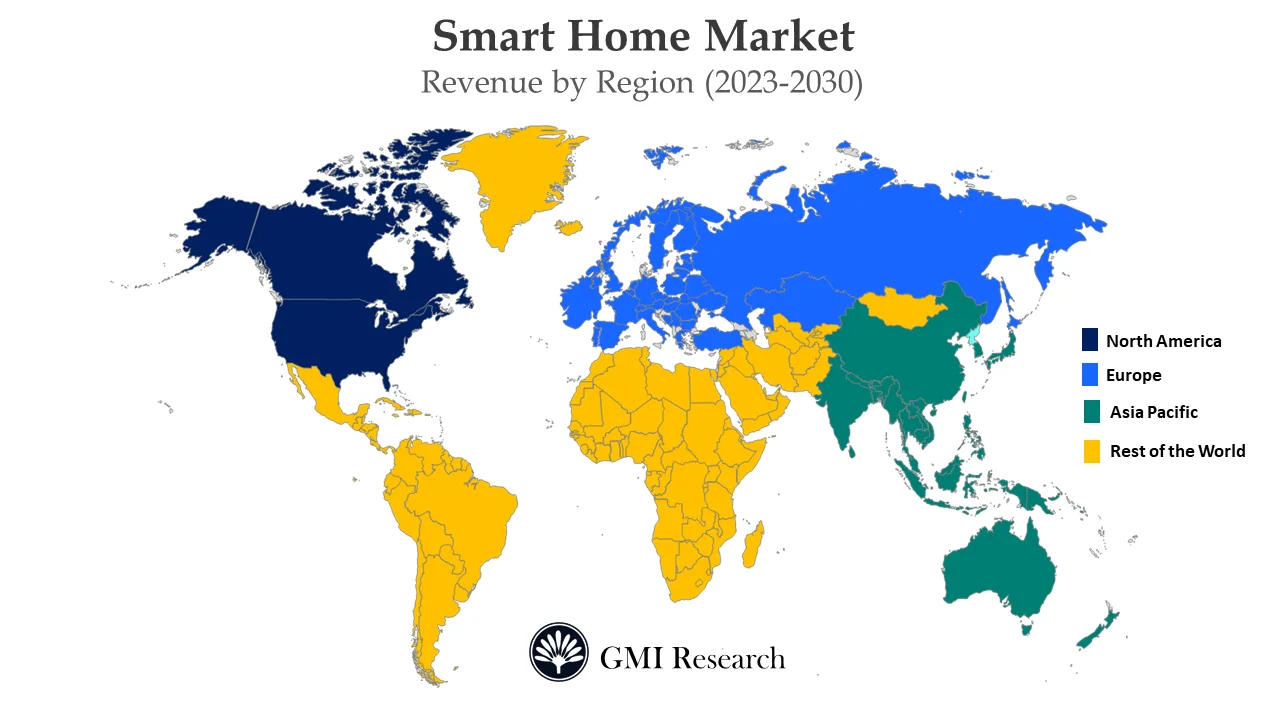
Asia-Pacific Smart Home Market is forecast to grow ta the fastest rate of 16.1% between 2026 and 2033, driven by increasing geriatric population, advancements in smart home products, presence of massive consumer base, rapid urbanization and rising penetration of smartphones and internet. China Smart Home Market is the largest in the region primarily driven by increasing consumers inclination towards adopting healthy lifestyles, rising disposable incomes, government policies promoting the usage of IoT based devices and growing demand for low-carbon emissions solutions.
Smart Home Market Major Players & Competitive Landscape
Several leading companies are Siemens AG, ABB, Johnson Controls, Schneider Electric, United Technologies, Amazon Inc., Apple, Google, ADT, Robert Bosch, Haier Smart Home, Xiaomi, LG, Samsung, LG Electronics, Copeland, Signify, Dyson, Brinks Home, Control4 Corporation, Ecobee, Assa Abloy and many more.
Chinese smart home brands continue to expand their market share, supported by competitive pricing, favorable government policies, and a large domestic consumer base. The rapid growth of China’s smart home market is driven by its vast population, extensive household base, accelerated deployment of digital and network infrastructure, and strong government support for digital transformation. Leveraging their scale, technological capabilities, and cost competitiveness, Chinese companies are also strengthening their presence across international markets.
Key Smart Home Market Developments
-
- On July 17, 2026, MKDWELL Tech Inc. has entered into an agreement to acquire Landvision Inc., which owns 100% of Landvision Technology Limited, a developer and supplier of AI-enabled smart-home and IoT products. Landvision operates across smart-home security, cooling appliances, and OEM/ODM solutions, with products including smart locks and connected devices, some Matter-certified for interoperability. The deal will diversify MKDWELL beyond automotive electronics and expand its presence in consumer smart-home markets while combining complementary expertise in embedded electronics, sensors, and Greater China-based manufacturing.
- In October 2022, Johnsons Control, a major manufacturer of smart building solutions announced that it has launched new flexible suite for its customers in Asia-Pacific. These services come with enhanced capabilities, which will allow remote monitoring and management of comprehensive range of HVAC controls.
Key Global Smart Home Market outlook
According to GMI Research analyst, the outlook for the global smart home market remains positive, supported by increasing consumer awareness of the convenience, security, and energy efficiency provided by smart home devices. The market is forecast to reach a value of USD 356.1 billion in 2033, growing at a CAGR of 11.2% till 2033.
Smart Home Market Report – Scope
|
Report Coverage |
Details |
| Market Size Value in 2025 |
USD 152.3 billion |
| Market Revenue Forecast in 2033 |
USD 356.1 billion |
| CAGR |
11.2% |
| Market Base Year |
2025 |
| Market Forecast Period |
2026-2033 |
| Base Year & Forecast Units |
Revenue (USD Billion) |
| Market Segment | By Device Category, By Residence Type, By Installation Type, By Connectivity Technology and By Key Regions |
| Regional Coverage | Asia Pacific, Europe, North America, and RoW |
| Companies Profiled | Siemens AG, ABB, Johnson Controls, Schneider Electric, United Technologies, Amazon Inc., Apple, Google, ADT, Robert Bosch, Haier Smart Home, Xiaomi, LG, Samsung, LG Electronics, Copeland, Signify, Dyson, Brinks Home, Control4 Corporation, Ecobee, Assa Abloy among others; a total of 22 companies covered. |
| 25% Free Customization Available | We will customize this report up to 25% as a free customization to address our client’s specific requirements |
Research Report Segmentation
The Global Smart Home Market has been segmented on the basis of Device Category, Residence Type, Installation Type, Connectivity Technology and Region. Based on Device Category, the market is segmented into Smart Entertainment Systems, Security and Access Control Systems, Lighting, HVAC, Healthcare Solutions, Kitchen, and Others. Based on Residence Type, the market is segmented into Single-Family and Multi-Family. Based on Installation Type, the market is segmented into New Installation and Retrofit Installation. Based on Connectivity Technology, the market is segmented into Wi-Fi, Zigbee, Z-Wave, Bluetooth BLE, and Others.
Global Smart Home Market by Device Category
-
- Smart Entertainment Systems
- Security and access control systems
- Lighting
- HVAC
- Healthcare Solutions
- Kitchen
- Others
Global Smart Home Market by Residence Type
-
- Single-Family
- Multi-Family
Global Smart Home Market by Installation Type
-
- New Installation
- Retrofit Installation
Global Smart Home Market by Connectivity Technology
-
- Wi-Fi
- Zigbee
- Z-Wave
- Bluetooth BLE
- Others
Global Smart Home Market by Region
-
-
North America Smart Home Market
- US Market
- Canada Market
-
Europe Smart Home Market
- UK Market
- Germany Market
- France Market
- Spain Market
- Rest of Europe Market
-
Asia-Pacific Smart Home Market
- China Market
- India Market
- Japan Market
- Rest of APAC Market
-
RoW Smart Home Market
- Brazil Market
- South Africa Market
- Saudi Arabia Market
- UAE Market
- Rest of world (remaining countries of the LAMEA region) Market
-
Smart Home Market Leading players
-
-
Siemens AG
-
ABB
-
Johnson Controls
-
Schneider Electric
-
United Technologies
-
Amazon Inc.
-
Apple
-
Google
-
ADT
-
Robert Bosch
-
Haier Smart Home
-
Xiaomi
-
LG
-
Samsung
-
LG Electronics
-
Copeland
-
Signify
-
Dyson
-
Brinks Home
-
Control4 Corporation
-
Ecobee
-
Assa Abloy
-
Frequently Asked Question About This Report
Smart Home Market – Published Report [ES03A-00-1217]
According to GMI Research analyst, Smart Home Market size was estimated at USD 152.3 billion in 2025
Smart Home Market is being shaped by several converging drivers including the widespread adoption of IoT and connected devices, growing consumer demand for intelligent home automation, and an increasing focus on energy efficiency. Complementing these are the rapid rollout of 5G and high-speed broadband, rising home security and safety concerns, and the seamless integration of artificial intelligence and voice assistant technologies.
GMI Research believes the market has strong opportunity for expansion and the market size is forecast to touch USD 356.1 billion in 2033 growing at a CAGR of 11.2% between 2025 and 2033.
Major players are Siemens AG, ABB, Johnson Controls, Schneider Electric, United Technologies, Amazon Inc., Apple, Google, ADT, Robert Bosch, Haier Smart Home, Xiaomi, LG, Samsung, LG Electronics, Copeland, Signify, Dyson, Brinks Home, Control4 Corporation, Ecobee, Assa Abloy and many more.
North America smart home market was valued at USD 54.1 billion in 2025 and is projected to grow at a CAGR of 7.8% during 2026–2033, driven by the United States, which accounted for 87% of the regional market, valued at approximately USD 47 billion, owing to the country's highest smart home device penetration globally. Meanwhile, the Asia-Pacific smart home market is expected to register the fastest growth, expanding at a CAGR of 16.1% during 2026–2033, supported by rapid urbanization, rising disposable incomes, and increasing adoption of connected home technologies. The Europe smart home market was valued at USD 46.1 billion in 2025 and is anticipated to grow at a CAGR of 8.6% between 2026 and 2033, driven by increasing consumer demand for energy-efficient, secure, and automated home solutions.
Smart entertainment systems, comprising video entertainment devices and smart speakers, accounted for the largest share of the smart home market in 2025. Networked video entertainment devices, including smart TVs, streaming devices, and internet-connected set-top boxes, represented the largest share of global smart home device shipments.
Retrofit installations type captures 59% of market share in 2025 owing to as its enable homeowners to upgrade existing properties into smart homes without extensive rewiring or structural modifications.
Wi-Fi accounted for 62% of the market share in 2025 due to as it is the most preferred connectivity technology for smart homes due to its widespread adoption, ease of installation, and ability to leverage existing home networks.
Related Reports
Why GMI Research