
Small Satellite Market Size, Share, Trends and Growth Report – Global Opportunities & Forecast, 2026-2033
Small Satellite Market Overview
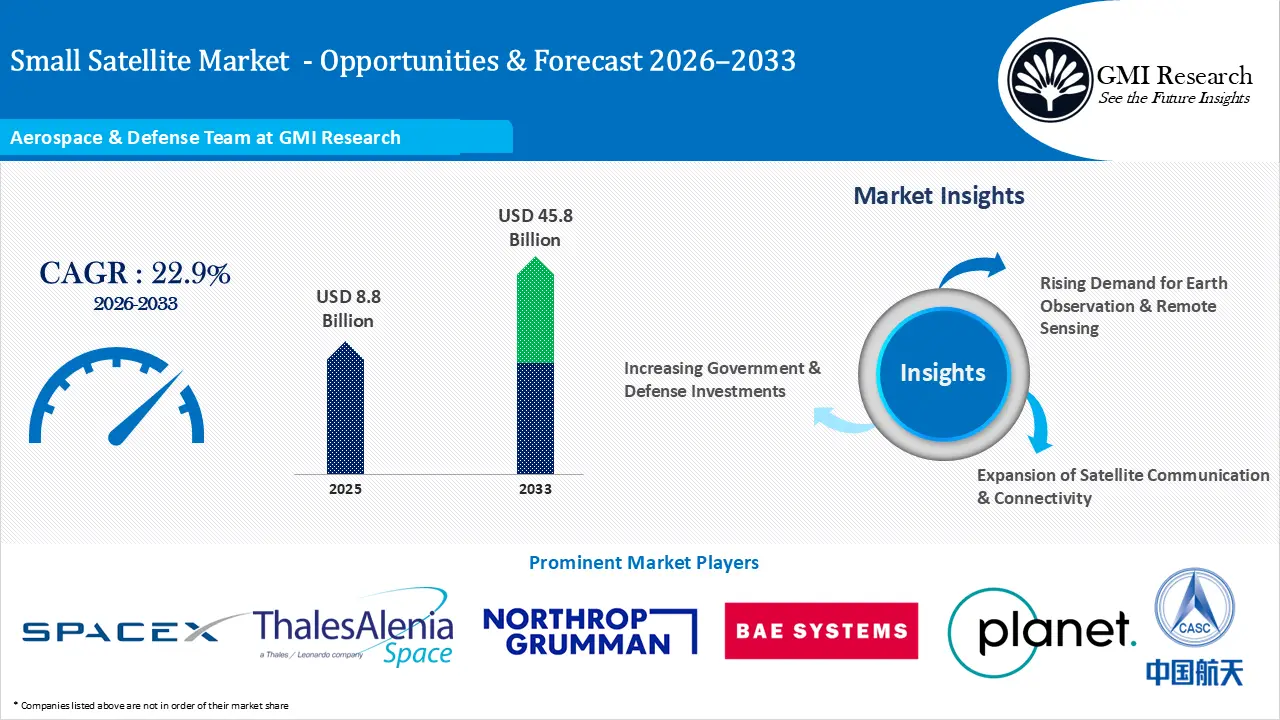
Small Satellite Market was valued at USD 8.8 billion in 2025 and is forecast to touch USD 45.8 billion in 2033, and the market is expected to grow at a whopping CAGR of 22.9% from 2026-2033 owing to rising demand for earth observation & remote sensing, expansion of satellite communication & connectivity, increasing government & defence investments.
Key Segment Insights:
-
- Satellite Mass Type Insights: Mini satellites weighing between 201 and 1,200 kg accounted for the largest market share in 2025.
- Application Type Insights: The communication segment held the highest market share in 2025 and is expected to maintain its dominance throughout the forecast period.
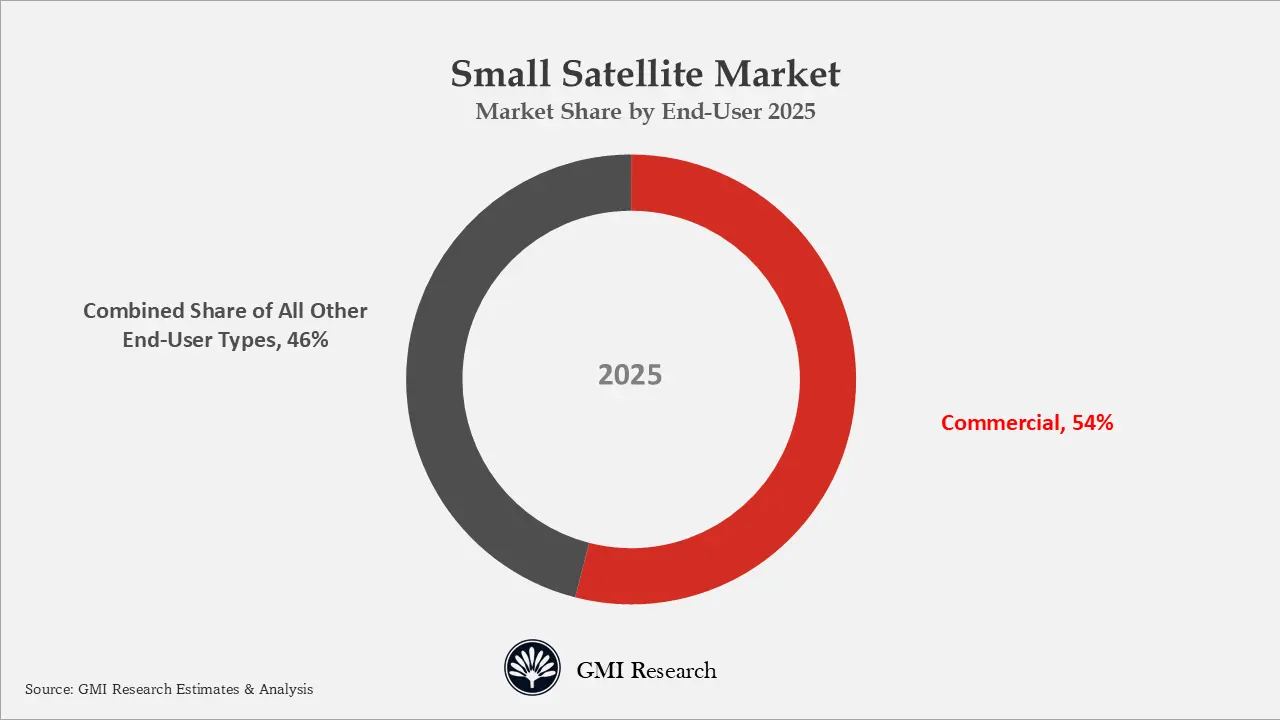
- End-User Insights: The commercial segment generated the highest market revenue share of 54% in 2025.
- Propulsion Technology Insights: Electric propulsion technologies are witnessing increasing adoption across satellite platforms.
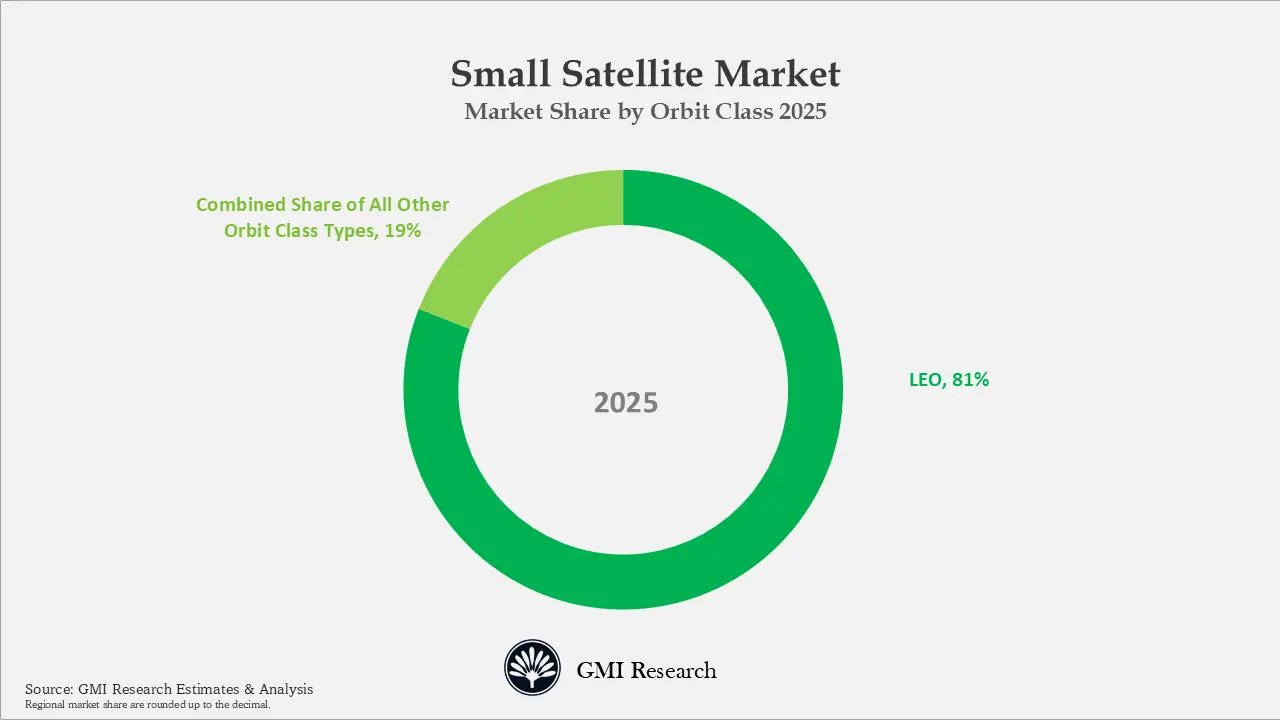
- Orbit Class Insights: Low Earth Orbit (LEO) represented the largest market share, accounting for 81% in 2025.
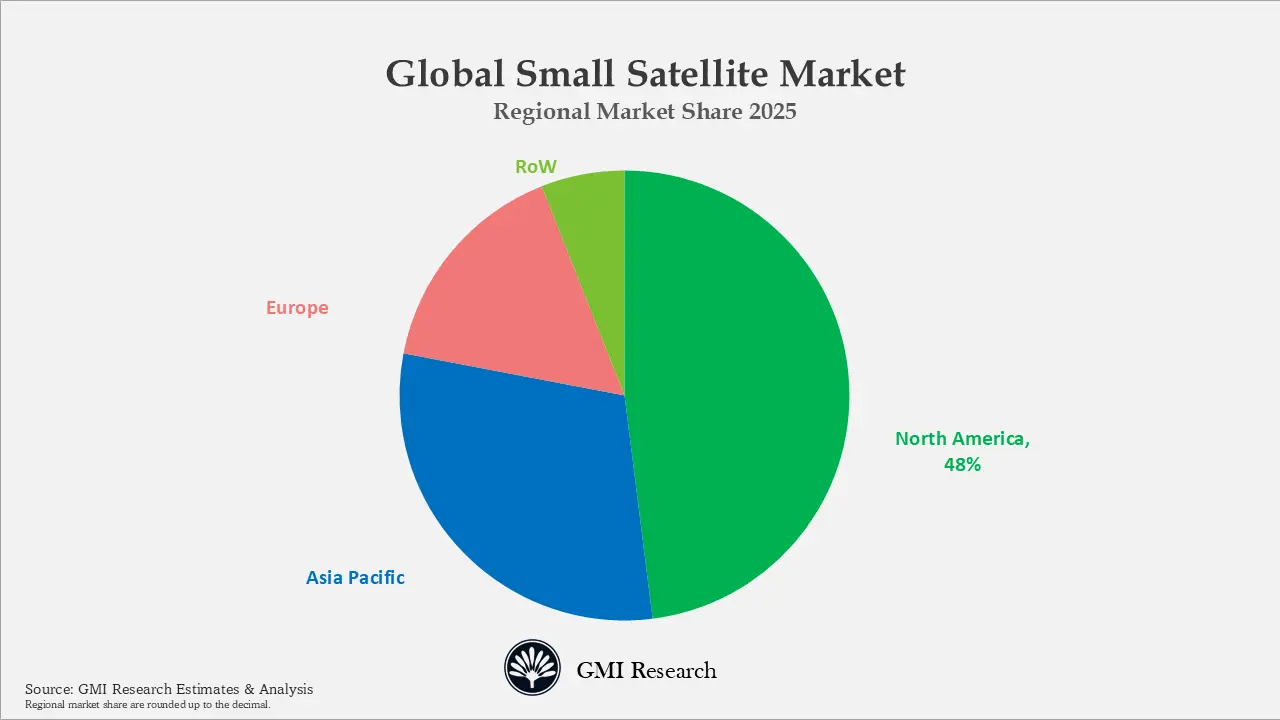
- Regional Market Insights: North America region holds the largest market share of 48% in 2025.
Market Size & Forecast:
-
- 2025 – USD 8.8 Billion
- 2026 – USD 11.2 Billion
- 2033 – USD 45.8 Billion
- Market Forecast – CAGR of 22.9% from 2026-2033
Small Satellite Market Growth Drivers
Rising Demand for Earth Observation & Remote Sensing
The emerging need for remote sensing and Earth observation services across several industries, including oil & gas, energy, defense, agriculture, etc., is fueling the global small satellite market. is also stimulating the global market.
Advancements in Earth Observation (EO) satellite technologies are improving global climate monitoring through enhanced coverage, higher-resolution imagery, and faster revisit rates. The rise of small satellites and advanced EO platforms has expanded access to reliable and continuous climate data.
At the same time, AI- and ML-driven climate models are enabling faster and more accurate forecasting and impact assessments, supporting near real-time decision-making during weather and disaster events. Emerging technologies such as AR, VR, and digital twins are also making complex EO data more interactive and easier to interpret, helping policymakers and communities strengthen climate resilience strategies driving global small satellite market forecast.
Demand for remote sensing data is steadily increasing, driven by the integration of diverse data sources such as satellite Earth observation, aerial photography, drone imagery, and ground-based measurements. Going forward, remote sensing data is expected to see broader adoption across government agencies, businesses, and individual applications.
Furthermore, small satellites capable of providing enhanced earth observation finds extensive usage in various sectors such as agriculture, energy, civil engineering, oil & gas, and others. However, the high cost incurred on research and development, manufacturing, and technology transfer to underdeveloped regions might hinder the market growth.
Expansion of Satellite Communication & Connectivity
Increased demand for small satellites for communication purposes, growing need for hosted payloads as well as rise in the development of dedicated launch vehicles for small satellites are the other key factors which are fueling the growth of the market.
Rising demand for reliable, high-speed connectivity is driving the adoption of satellite communication technologies, particularly in remote and challenging environments such as maritime, mining operations and remote locations. Advancements in satellite technology from traditional low-bandwidth geostationary satellites to high-throughput Low Earth Orbit (LEO) constellations are significantly improving global communication capabilities and supporting increasingly data-intensive applications.
Increasing Government & Defense Investments
Global military spending reached a historic high of $2.7 trillion in 2024, marking a 9.4% year-on-year increase with all regions recording growth, according to SIPRI. The U.S., China, Russia, Germany, and India collectively accounted for around 60% of total expenditure. Rising geopolitical tensions particularly involving the U.S., Israel, and Iran are expected to drive defense budgets even higher. The defence sector are using small satellites for enabling military operations by enabling fast data collection and tactical communications, ultimately improving situational awareness on the ground.
The growing use of small satellites across civil, military, and government agencies for communication and navigation applications, because of the growing adoption of advanced technologies will expand the market growth.
Countries with limited space infrastructure are increasingly investing in their own satellites for communications and observation, moving away from commercial data services and shared partnerships. Falling launch costs and the widespread availability of ready-made satellites have made this more accessible will drive demand for small satellites.
Small Satellite Market Segment Analysis
Satellite Mass Type Market Insights: Mini Satellites weighing (201 to 1200 KG) dominates the market share in 2025.
Mini Satellites weighing (201 to 1200 KG) hold the largest market share in 2025 and capturing around tow third of the total small satellites launches. Since 2023, the satellite industry has seen a growing deployment of mini-class small spacecraft constellations weighing 201–600 kg, alongside the emergence of a new generation of larger small spacecraft constellations in the 600–1,200 kg range. The near-Earth satellite ecosystem has expanded rapidly over the past decade, particularly in Low Earth Orbit (LEO), where satellite numbers have increased hundreds of times in just five years. Companies like Starlink have already deployed tens of thousands of satellites, with additional large-scale launch initiatives planned by other operators.
Micro satellite weighting (11 to 200 KG) hold the second largest launches in 2025 after mini satellites. Nanosatellites segment is projected grow during the forecast period. Nanosatellites provide quicker, cost-effective and reliable access to space. These satellites can be used for complex space missions such as disaster management, environmental monitoring, scientific research and exploration, communication, military intelligence, navigation and other academic purposes. The less stringent regulations, less complex manufacturing process and low cost are the key factors fuelling the growth of nanosatellites market. Also, the rising research and development activities and increasing number of space laboratories for upcoming missions will augment the market growth.
Application Type Market Insights: Communication segment hold the largest market share of and is projected to dominate during the forecast period.
The communication segment accounted for the largest market share in 2025 and is expected to maintain its dominance throughout the forecast period primarily owing to growing demand for dependable, high-speed connectivity is accelerating the adoption of satellite communication technologies, especially across remote and challenging environments such as maritime operations, mining sites, and isolated locations.
Earth Observation segment is projected to grow at a robust rate due to their increased demand in the commercial, civil and military use globally. The ability of these satellites to monitor situations like hurricanes, cyclones, earthquakes, powerplant disasters, storms, volcanic activities, will strengthen the market growth. The compact nature of small satellites helps to effectively observe earth, which will expand the segment’s growth.
End-User Market Insights: Commercial segment hold the largest market revenues share of 54% in 2025
Commercial segment accounted for the largest market share and is projected to dominate during the forecast period owing to growing demand for satellite based broadband connectivity globally. The satellite-based navigation systems and internet services will be the key trends which will fuel the growth of said market. The use of geospatial technology for earth imaging applications such as agriculture monitoring, navigation, natural disaster monitoring has further spurred the commercial small satellite market. The accelerating penetration of internet services and mobile phones and rising implementation of satellites for enemy surveillance will augment the segment’s growth.
Propulsion Tech Type Market Insights: Electric based propulsion is getting traction.
In terms of small satellite propulsion systems market, electric propulsion is gaining adoption due to its high fuel efficiency, enabling lower spacecraft mass and greater payload capacity. For small satellites such as CubeSats, it supports complex manoeuvres like station-keeping and orbit raising while using significantly less propellant than conventional chemical propulsion systems.
Orbit Class Type Market Insights: LEO captures the largest market share of 81% in 2025.
LEO holds the largest market share of 81% in 2025 owing to as Low Earth Orbit (LEO), located between 200 and 2,000 km above Earth’s surface, is the preferred orbit for small satellites due to its lower launch energy requirements and reduced deployment costs compared to higher orbits.
Small Satellite Market Share by Region Market Analysis: North America region accounted for the largest market share of 48% in 2025.
Small satellite market share by region, North America region hold the largest market share of 48% in 2025 and is set to record a robust CAGR growth over the forecast period. The presence of key players having an increased focus towards small satellite development and growing demand for communication, earth observation small satellites are the major factors which are fuelling the growth of the market in the region. In addition, the market for small satellite is also expected to grow in the Asia-Pacific region during the forecast period. The increasing focus towards lowering total mission costs is the key factor propelling the growth of the market in the region. The government of emerging economies in the region are investing substantially on their development as these are satellites are cheaper, reliable and more economical. The small satellite is expected to register further growth in the emerging economies such as India and China.
Europe market is estimated to grow at rapidly over the upcoming years, owing to the existence of nascent rocket manufacturers, like Isar Aerospace and Rocket Factory Augsburg, to use small satellites into orbit. The strong funding by VCs and government agencies in space exploration and remote sensing capabilities is projected to bolster the market growth.
Small Satellite Market Major Players & Competitive Landscape
Some of the leading small satellite companies worldwide SpaceX, China Aerospace Science and Technology Corporation, Airbus SE, Thales Alenia Space, Space Exploration Technologies Corp., Chang Guang Satellite Technology Co. Ltd., Lockheed Martin, Planet Labs, Northrop Grumman, BAE Systems, RTX, MDA Space, L3Harris Technologies and many more. Surge in demand for small satellite is prompting a growing number of service providers to enter the market.
Key Small Satellite Market Developments
-
- In May 2026, Skyroot Aerospace has raised $60 million in a funding round co-led by Sherpalo Ventures and GIC, making it India’s first spacetech unicorn. The round attracted notable new investors including BlackRock, Playbook Partners, and Shanghvi Family Office, alongside existing backers such as the founders of Greenko Group and Arkam Ventures.
- In April 2026, The United States Space Force selected 14 companies to compete under the $1.8 billion Andromeda program, a 10-year procurement initiative managed by Space Systems Command. The program focuses on developing satellites and supporting technologies to monitor activities in geosynchronous orbit through competitive task orders.
- In Oct 2025, Airbus, Leonardo, and Thales have signed an MoU to combine their space activities into a new European space company. The partnership aims to strengthen Europe’s strategic autonomy, enhance innovation, and improve global competitiveness in satellite infrastructure and space services. By leveraging complementary technologies and expertise, the venture is expected to expand commercial opportunities, drive operational synergies, and generate significant long-term value through integrated end-to-end space solutions.
Small Satellite Market Scope of the Report
|
Report Coverage |
Details |
| Market Size Value in 2025 |
USD 8.8 billion |
| Market Revenue Forecast in 2033 |
USD 45.8 billion |
| CAGR |
22.9% |
| Market Base Year |
2025 |
| Market Forecast Period |
2026-2033 |
| Market Revenues Currency |
USD Billion |
| Base Year & Forecast Units |
Revenues (USD Billion) |
| Market Segment | By Mass, By Orbit Class, By Application, By End User, By Propulsion Tech and By Region |
| Regional Coverage | Asia Pacific, Europe, North America, and RoW |
| Companies Profiled | SpaceX, China Aerospace Science and Technology Corporation, Airbus SE, Thales Alenia Space, Space Exploration Technologies Corp., Chang Guang Satellite Technology Co. Ltd., Lockheed Martin, Planet Labs, Northrop Grumman, BAE Systems, RTX, MDA Space, L3Harris Technologies, among others; a total of 13 companies covered. |
| 25% Free Customization Available | We will customize this report up to 25% as a free customization to address our client’s specific requirements |
Small Satellite Market Research Report Segmentation
The Global Small Satellite Market has been segmented on the basis of Mass, Orbit Class, Application, End User, Propulsion Tech and Region. Based on the Mass, the market is segmented into Nano Satellites (1 to 10 KG), Micro Satellites (11 to 200 KG), and Mini Satellites (201 to 1200 KG). Based on the Orbit Class, the market is segmented into LEO, MEO, and GEO. Based on the Application, the market is segmented into Communication, Earth Observation, Navigation, and Others. Based on the End User, the market is segmented into Commercial, Military & Government and Other. Based on the Propulsion Tech, the market is segmented into Electric, Gas Based and Liquid Fuel.
Global Small Satellite Market by Mass
-
- Nano Satellites (1 to 10 KG)
- Micro Satellites (11 to 200 KG)
- Mini Satellites (201 to 1200 KG)
Global Small Satellite Market by Orbit Class
-
- LEO
- MEO
- GEO
Global Small Satellite Market by Application
-
- Communication
- Earth Observation
- Navigation
- Others
Global Small Satellite Market by End User
-
- Commercial
- Military & Government
- Other
Global Small Satellite Market by Propulsion Tech
-
- Electric
- Gas based
- Liquid Fuel
Global Small Satellite Market by Region
-
-
North America Small Satellite Market
- US Market
- Canada Market
-
Europe Small Satellite Market
- UK Market
- Germany Market
- France Market
- Spain Market
- Rest of Europe Market
-
Asia-Pacific Small Satellite Market
- China Market
- India Market
- Japan Market
- Rest of APAC Market
-
RoW Small Satellite Market
- Brazil Market
- South Africa Market
- Saudi Arabia Market
- UAE Market
- Rest of world (remaining countries of the LAMEA region) Market
-
Small Satellite Market Leading players
-
-
SpaceX
-
China Aerospace Science and Technology Corporation
-
Airbus SE
-
Thales Alenia Space
-
Space Exploration Technologies Corp.
-
Chang Guang Satellite Technology Co. Ltd.
-
Lockheed Martin
-
Planet Labs
-
Northrop Grumman
-
BAE Systems
-
RTX
-
MDA Space
-
L3Harris Technologies
-
Frequently Asked Question About This Report
Global Small Satellite Market [UP267A-00-1219]
Small Satellite Market size was estimated at USD 8.8 billion in 2025
Global small satellite market forecast is driven by the growing demand for Earth observation and remote sensing capabilities, the expansion of satellite communication and connectivity services, and increasing government and defense investments.
Small Satellite Market size is forecast to reach USD 11.2 billion in 2026
Small Satellite Market has room for substantial growth and the market size is forecast to reach USD 45.8 billion in 2033, and the market is expected to grow at a whopping CAGR of 22.9% from 2026-2033.
Some of the major players are SpaceX, China Aerospace Science and Technology Corporation, Airbus SE, Thales Alenia Space, Space Exploration Technologies Corp., Chang Guang Satellite Technology Co. Ltd., Lockheed Martin, Planet Labs, Northrop Grumman, BAE Systems, RTX, MDA Space, L3Harris Technologies and many more. Surge in demand for small satellite is prompting a growing number of service providers to enter the market.
North America region holds the largest market share of 48% in 2025.
Mini satellites weighing between 201 and 1,200 kg accounted for the largest market share in 2025.
The communication segment held the highest market share in 2025 and is expected to maintain its dominance throughout the forecast period.
Electric propulsion technologies are witnessing increasing adoption across satellite platforms.
US dominates the global small satellite market owing to presence of large players such as SpaceX
The commercial segment generated the highest market revenue share of 54% in 2025.
Related Reports
Why GMI Research