
IoT Chip Market Size, Share, Trends and Growth Report – Global Opportunities & Forecast, 2026-2033
IoT Chip Market Overview
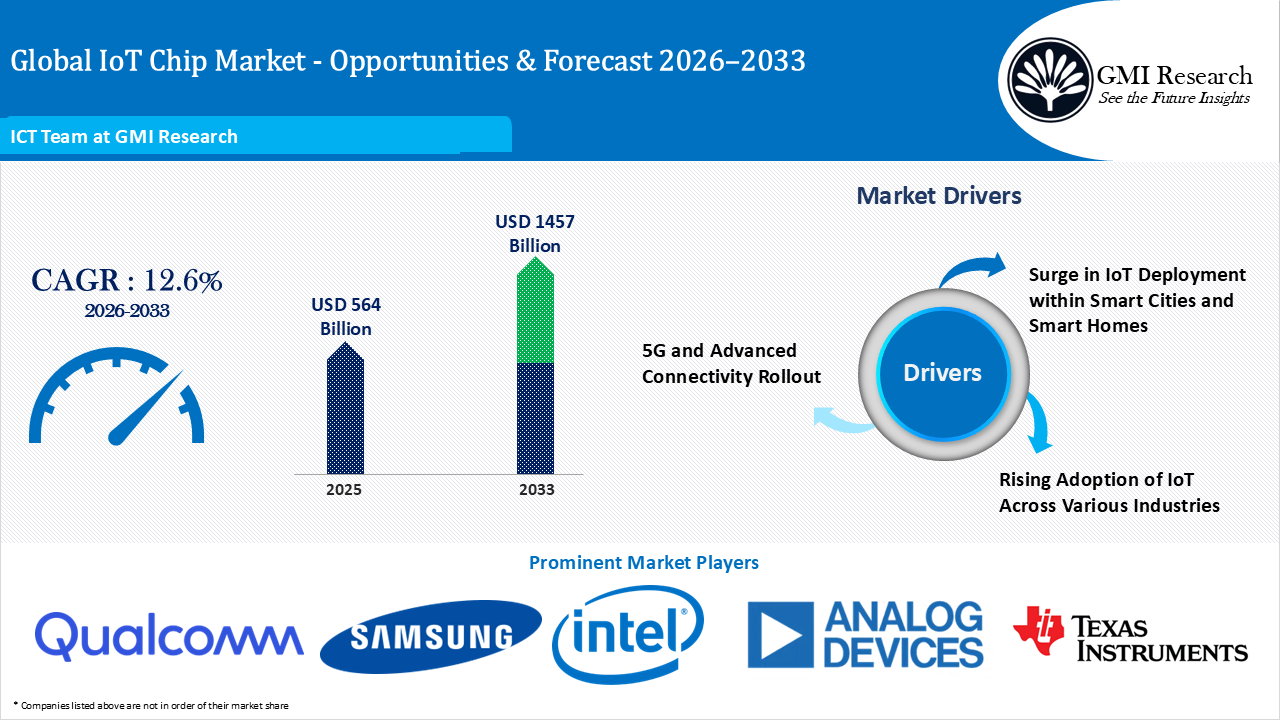
IoT Chip Market size was valued at USD 564 billion in 2025 and is projected to reach USD 1,457 billion in 2033, growing at a CAGR of 12.6% during the forecast period from 2026-2033, due to the surge in IoT deployment within smart cities and homes along with its rising adoption of IoT across various industries.
Market Size & Forecast:
-
- 2025 – USD 564 Billion
- 2033 – USD 1,457 Billion
- Market Forecast – CAGR of 12.6% from 2026-2033
Key Segment Insights:
-
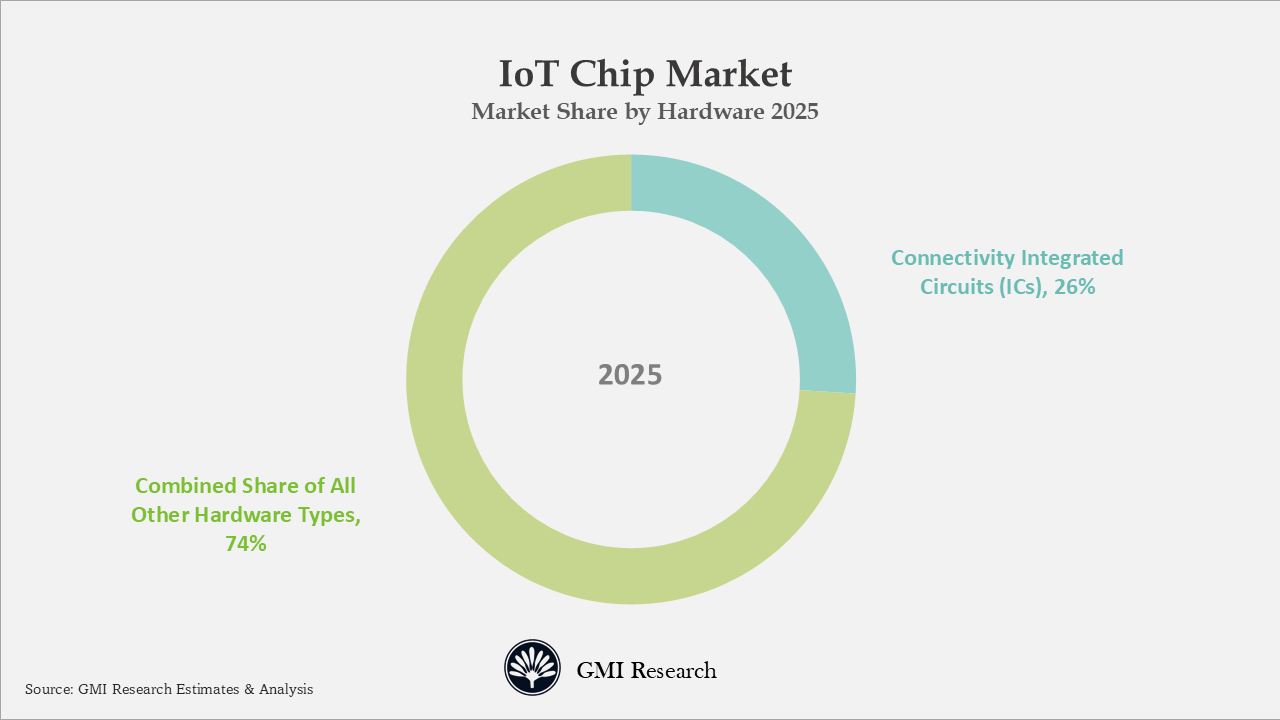
- Hardware Type Insights: The connectivity ICs segment represented around 26% of total market share in 2025.
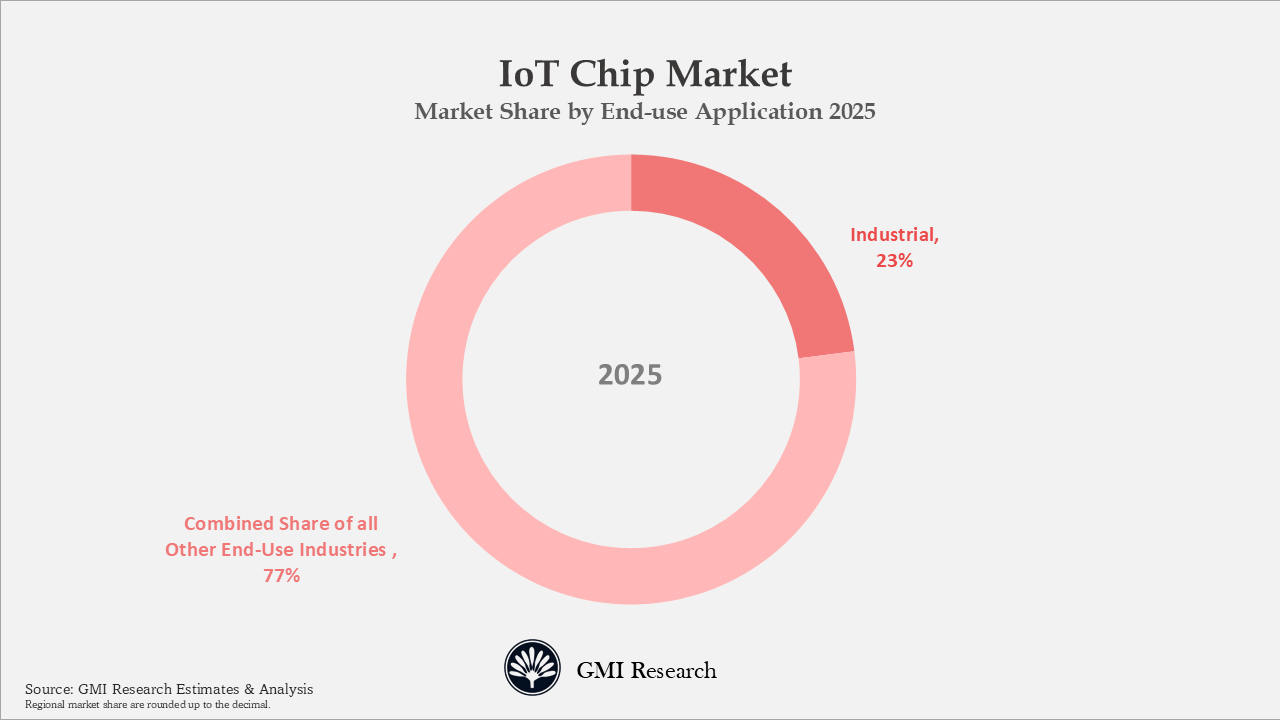
- End-Use Application Insights: The industrial segment contributed approximately 23% of total revenue in 2025.
- Regional Insights: Asia Pacific accounted for nearly 35% of the global market share in 2025.
IoT Chip Market Growth Drivers
Surge in IoT Deployment within Smart Cities and Smart Homes along with Rising Adoption Across Various Industries.
The IoT Chip Market size growth is driven by increasing digitalization as the growth of smart homes and cities creates a higher demand for IoT devices that need better processing capabilities and connectivity. These chips are crucial for providing the connectivity and energy efficiency necessary for IoT devices to operate efficiently. As interconnected devices are growing, the need for high-performance IoT chips is anticipated to increase in the years ahead.
The growing need for IoT devices across industries including industrial automation and consumer electronics is further driving the IoT Chip Market growth. As industries seek greater automation and remote monitoring, there has been a rising need for IoT devices that can handle extensive data while offering real-time analytics. Semiconductor companies are also developing AI architectures including embedded GPUs and accelerators to address the rising demand for IoT devices powered by artificial intelligence.
IoT in retail has also changed the way businesses connect with customers. This technology enables retailers to improve efficiency while enhancing the customer journey. Retailers can streamline inventory and manage supply chain while also leveraging instant analytics to make informed decisions. Its applications are broad with notable implications in areas such as smart doors or shelves and inventory management.
Challenges Faced by IoT Chip Market Companies
With rapid adoption in industries such as retail and healthcare, IoT holds immense potential. However, data privacy and security remain major obstacles that can hinder its market growth. As IoT adoption rises for numerous applications, the surge in connected devices generates massive amounts of data which creates opportunities for cybercriminals to infiltrate systems and exploit this information for malicious activities. Still companies see cybersecurity is their biggest challenge in implementing IoT.
IoT Chips Market Segment Analysis
Hardware Type Market Insights: Connectivity ICs segment accounted for 26% of the market share in 2025.
Connectivity ICs dominated the market largely because of the vital role these components play in the functioning of IoT applications. The growing IoT ecosystem highlights the critical need for smooth and dependable data exchange between devices. This segment delivers the crucial hardware necessary for multiple wireless communication standards which allow devices to connect and transfer data seamlessly via cellular networks or various technologies.
The sensors segment is also expanding because of their vital role in collecting data and sensing. They allow the IoT ecosystem to gather real-time data from the physical environment and support various IoT applications. Sensors are integral to healthcare applications like remote monitoring and health tracking. While in manufacturing they help with predictive maintenance and optimizing processes.
The processors segment is expected to experience significant growth due to the widespread IoT devices uses in sectors like healthcare and industrial automation which require more advanced processors. As IoT applications often involve sensitive data, the inclusion of improved security features in processors is becoming increasingly important. It drives market growth by ensuring comprehensive defense against online threats.
End-use Application Market Insights: Industrial segment accounted for 23% of the revenue share in 2025
Industrial segment holds 23% of the market share in 2025 owing to as across industries, IoT adoption is moving beyond simple monitoring and tracking toward sophisticated predictive, AI-driven, and automated implementations. The industrial segment is also expanding as the demand for IoT in manufacturing rises. It is driven by the growing number of M2M connections and the rising need for better efficiency on the factory floor and in the field. Many manufacturers deploy IoT devices to take advantage of predictive maintenance and advanced data analytics which enhances productivity while adding significant value for their business operations.
Consumer electronics segment is projected to register the fastest growth owing to as this segment encompasses devices like smart speakers and home appliances which are integrating IoT chipsets to support remote control along with compatibility with virtual assistants like Google Assistant or Amazon Alexa. IoT chipsets are also embedded in home automation solutions which allows users to remotely control various aspects of their home including security and lighting through smartphones or predefined automation routines.
The healthcare segment is projected to grow with the increasing use of IoT devices like fitness trackers and pulse sensors which enable monitoring of vital signs. It allows healthcare providers to monitor health data and respond swiftly to any changes.
Regional Insights: Asia Pacific hold 35% of the market share in 2025
The Asia Pacific region is expected to experience substantial growth driven by widespread mobile and internet access in several countries which facilitate the smooth deployment and integration of IoT services. The region is also experiencing a surge in innovation within processor technology with IoT chip manufacturing companies focusing on creating more powerful processors designed specifically for IoT applications.
North America benefits from a robust and sophisticated telecommunications infrastructure featuring broad high-speed internet access and extensive cellular coverage which facilitates IoT devices deployment. Private sector investments and government efforts are playing a vital role in accelerating IoT technology expansion in North America. Programs focused on smart cities and industrial automation are also attracting significant financial backing.
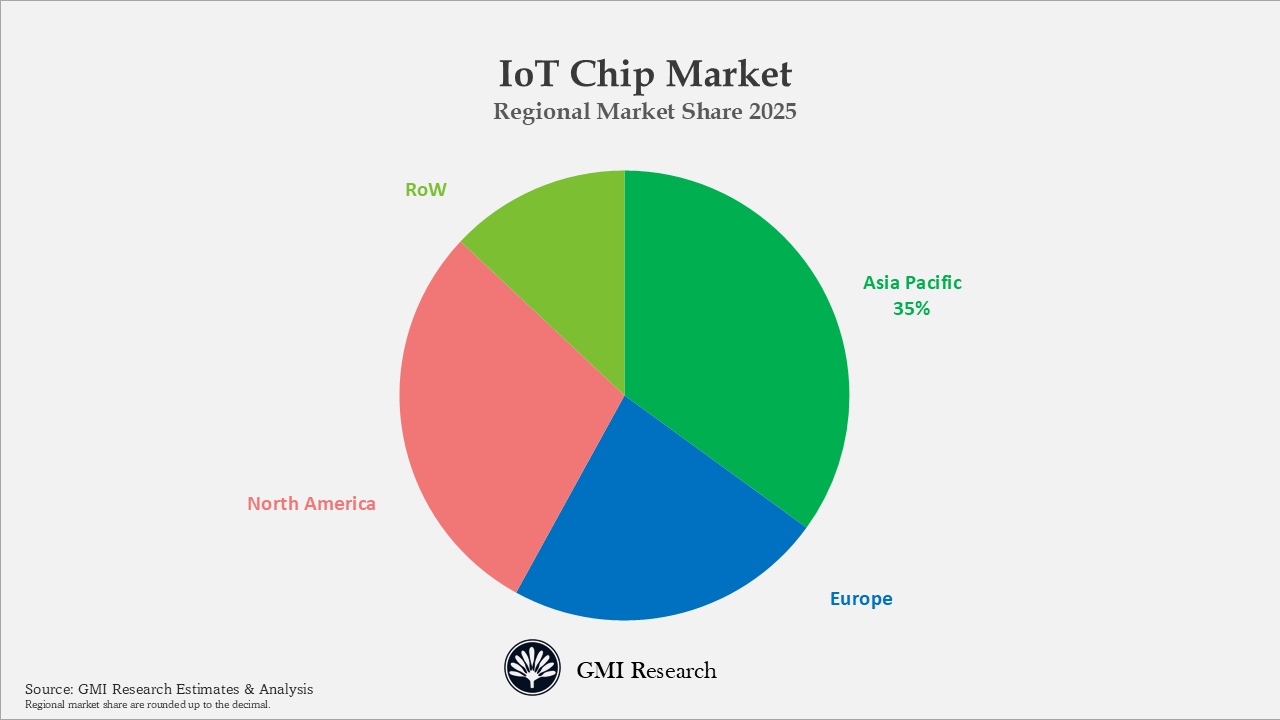
Manufacturing leaders like China and Japan are embracing the Industrial IoT to improve predictive maintenance and optimize supply chains. It can also automate factories which eventually drive higher productivity and operational efficiency. Rising internet penetration in residential or commercial sectors along with increasing disposable income and better IT infrastructure are all contributing to market growth in the APAC region.
Europe is expected to experience consistent growth in the coming years driven by its robust regulatory environment that prioritizes data security and privacy such as the implementation of the General Data Protection Regulation. A strong focus on personal data protection is essential for the widespread integration with IoT technologies. European countries have therefore been actively fostering IoT adoption with favorable initiatives and policies. Research and development investments by governments along with funding schemes and partnerships with industry players are further driving market growth in Europe.
IoT Chip Market Major Players & Competitive Landscape
Several leading companies are Intel Corporation, Qualcomm, Samsung, Texas Instrument, MediaTek, NXP Semiconductors, Analog Devices, Microchip Technology Inc. Broadcom, Infineon, Cypress Semiconductor among others.
The market is defined by ongoing technological innovations and shifting consumer needs. The need for better performance and power efficiency is pushing companies to compete fiercely in developing sophisticated IoT chip technology. Companies ranging from large semiconductor firms to emerging IoT chip producers are competing for market share and striving to secure their position in this rapidly changing sector.
Key IoT Chip Market Developments
-
- In 2024, Qualcomm Technologies introduced an IoT chip with ultra-low energy WiFi aimed at rivaling Bluetooth technology. The chip is designed to solve power consumption and connectivity issues in IoT devices. It also enhances battery life and delivers superior performance for numerous devices.
- In 2024 NXP Semiconductors and Honeywell collaborated to improve building power management. This collaboration seeks to deliver intelligent energy solutions powered by AI and data analytics. This also enhances building autonomy and optimizes energy with guidance from service professionals.
- In 2023 Qualcomm Technologies unveiled the QCM8550 and QCS8550 IoT chips. They offer higher power for applications including cloud gaming and drones.
- In 2023, Samsung launched the Exynos Connect U100 which is an ultra wideband chipset with high precision designed for automotive devices and smartphones as it offers centimeter level accuracy. Optimized for automotive and IoT applications, the solution delivers precise distance along with location tracking.
IoT Chip Market Scope of the Report
|
Report Coverage |
Details |
| Market Size Value in 2025 |
USD 564 billion |
| Market Revenue Forecast in 2033 |
USD 1,457 billion |
| CAGR |
12.6% |
| Market Base Year |
2025 |
| Market Forecast Period |
2026-2033 |
| Base Year & Forecast Units |
Revenues (USD Billion) |
| Market Segment | By Hardware, By Power Consumption, By End-use Application, By Region |
| Regional Coverage | Asia Pacific, Europe, North America, and RoW |
| Companies Profiled | Intel Corporation, Qualcomm, Samsung, Texas Instrument, MediaTek, NXP Semiconductors, Analog Devices, Microchip Technology Inc. Broadcom, Infineon, Cypress Semiconductor , among others; a total of 11 companies covered. |
| 25% Free Customization Available | We will customize this report up to 25% as a free customization to address our client’s specific requirements |
IoT Chip Market Research Report Segmentation
The Global Internet of Things (IoT) Chip Market has been segmented on the basis of hardware, power consumption, end-use application, and regions. Based on the hardware, the market is segmented into processors, connectivity integrated circuits (ICs), sensors, memory devices, and logic devices. Based on the power consumption, the market is segmented into less than 1 W, 1–3 W, 3–5 W, 5–10 W, and more than 10 W. Based on the end-use application, the market is segmented into automotive, banking financial services and insurance, retail, healthcare, consumer electronics, industrial, and others.
Global IoT Chip Market by Hardware
-
- Processors
- Connectivity Integrated Circuits (ICs)
- Sensors
- Memory devices
- Logic devices
Global IoT Chip Market by Power Consumption
-
- Less than 1 W
- 1–3 W
- 3–5 W
- 5–10 W
- More than 10 W
Global IoT Chip Market by End-use Application
-
- Automotive
- Banking Financial Services and Insurance
- Retail
- Healthcare
- Consumer Electronics
- Industrial
- Others
Global IoT Chip Market by Region
-
-
North America IoT Chip Market
- US Market
- Canada Market
-
Europe IoT Chip Market
- UK Market
- Germany Market
- France Market
- Spain Market
- Rest of Europe Market
-
Asia-Pacific IoT Chip Market
- China Market
- India Market
- Japan Market
- Rest of APAC Market
-
RoW IoT Chip Market
- Brazil Market
- South Africa Market
- Saudi Arabia Market
- UAE Market
- Rest of world (remaining countries of the LAMEA region) Market
-
IoT Chip Market Leading players
-
-
Intel Corporation
-
Qualcomm
-
Samsung Electronics
-
Texas Instruments
-
MediaTek
-
NXP Semiconductors
-
Analog Devices
-
Microchip Technology Inc.
-
Broadcom Inc.
-
Infineon Technologies
-
Cypress Semiconductor
-
Frequently Asked Question About This Report
IoT Chip Market [GR24AB-01-00357]
IoT Chip Market size was estimated at USD 564 billion in 2025
IoT Chip Market is growing due to the surge in IoT deployment within smart cities and homes along with its rising adoption of IoT across various industries.
IoT Chip Market significant growth potential and the market size is projected to reach USD 1,457 billion in 2033, growing at a CAGR of 12.6% during the forecast period from 2026-2033.
Major players operating in IoT Chip market are Corporation, Qualcomm, Samsung, Texas Instrument, MediaTek, NXP Semiconductors, Analog Devices, Microchip Technology Inc. Broadcom, Infineon, Cypress Semiconductor among others.
In 2025, the Asia-Pacific region captured 35% of the IoT chip market share and is poised for robust growth, fueled by extensive mobile and internet penetration across key countries that enable seamless IoT service deployment and adoption.
The industrial segment contributed approximately 23% of total revenue in 2025.
Connectivity ICs segment represented around 26% of total market share in 2025.
Related Reports
Why GMI Research