Gas Turbine Market Size, Share, Growth, Trends Analysis & Industry Forecast Report, 2026-2033
Gas Turbine Market Overview
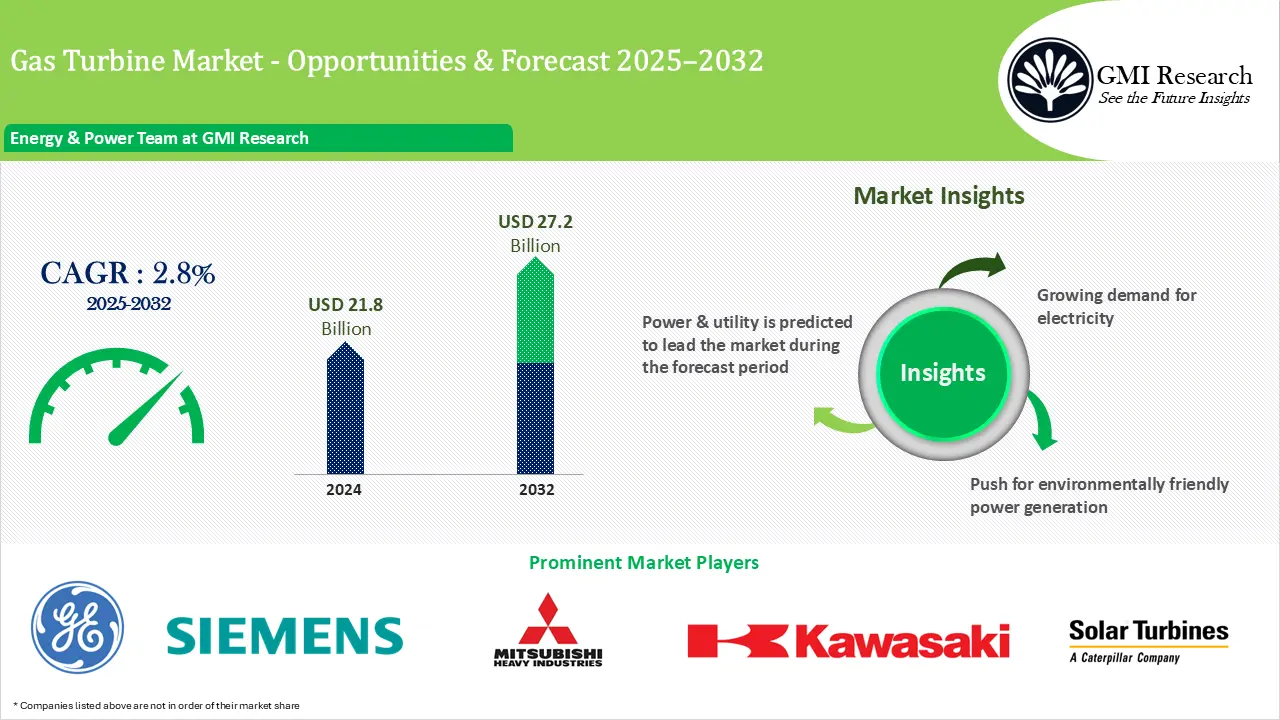
Gas Turbine Market size was valued at USD 22.6 billion in 2025 and is forecast to touch USD 31.1 billion in 2033, and the market is projected to grow at a CAGR 4.1% between 2026 and 2033 primarily driven by growing demand for electricity and push toward environment friendly power generation, growing demand from data centres.
Market Size, Forecast & Key Segment Insights
Market Size & Forecast:
-
- 2025 – USD 22.6 Billion
- 2033 – USD 31.1 Billion
- Market Forecast – CAGR of 4.1% from 2026-2033
Segment Insights:
-
- Capacity Type Insights: 100 to <150 MW is expected to dominate the market over the forecast period.
- Technology Type Insights: Combined cycle is expected to grow at a faster CAGR over the forecast period.
- End-Use Industry Type Insights: Power & Utility end industry dominated the market revenues and is predicted to lead the market during the forecast period.
- Regional Insights: Asia Pacific accounts for the largest share of the market and is expected to register a faster CAGR over the forecast period. China remains one of the key contributors to growth in the region.
A gas turbine is a type of continuous and internal combustion engine which produces an electric current. It converts natural gas or any liquid fuel into machinal energy. For the generation of electricity, the gas turbines heat both air and fuel at very high temperatures, thus helping the turbine blade to spin.
Key Gas Turbine Market Drivers
Growing Demand for Electricity
Global demand for energy grew at an above-average rate in 2024, increasing demand for all forms of energy including oil, natural gas, coal, renewables and nuclear power. As per IEA, the global demand for electricity grew at 4.3% in 2024, a 1.8 pts jump from the 2.5% growth rate in 2023.The average rate of increase in electricity demand between 2010 and 2023 was 2.7%, which was twice the pace of increase in total energy demand over the period. The advance of electrification came across sectors, lifting electricity demand in most large economies in 2024. Low-emissions sources supplied virtually all growth in global electricity, with solar PV alone exceeding the expansion of all fossil fuels. Gas demand rose significantly, and oil and coal consumption grew more slowly than in 2023.
Push for Environmentally Friendly Power Generation
The gas turbine provides benefits which include reduced operational costs, higher power density, and has lower emission. They are highly efficient comparatively to other combustion-based power generation technologies. The International Energy Agency’s Global Energy and CO2 Status Report of 2018 illustrates that the coal-fired power generating plants is one of the biggest contributors to the emission in 2018, which has increased by 2.9% from 2017. As per the gas turbine market forecast, the growing population and the rising emphasis on infrastructural development at the global level have led to an increase in the demand for electricity. This will further drive the growth of the gas turbine market share in terms of revenue.
Some of the major drivers that are contributing to the growth of the global gas turbine market size include the growing government support for power generation technologies with an aim to decrease carbon dioxide emission. The U.S. Department of Energy has introduced clean energy research, development, demonstration, & deployment (RDD&D) to bring progress in the U.S. climate and energy goals. As per the Energy Information Administration, natural gas is one of the biggest sources for electricity generation in the U.S. amounting for on third of share in the U.S. power generation. Additionally, shift from coal-based power generation towards gas-based power generation is one of the emerging gas turbine market trends that is surging the demand.
Challenges Faced by Gas Turbine Market Players
Gas turbine market outlook predicts that the increasing share of renewables in the electricity mix will hamper industry growth. In addition to this, the lack of suitable gas infrastructure in Asian countries further has a negative impact on the market growth.
Gas Turbine Market Segment Analysis
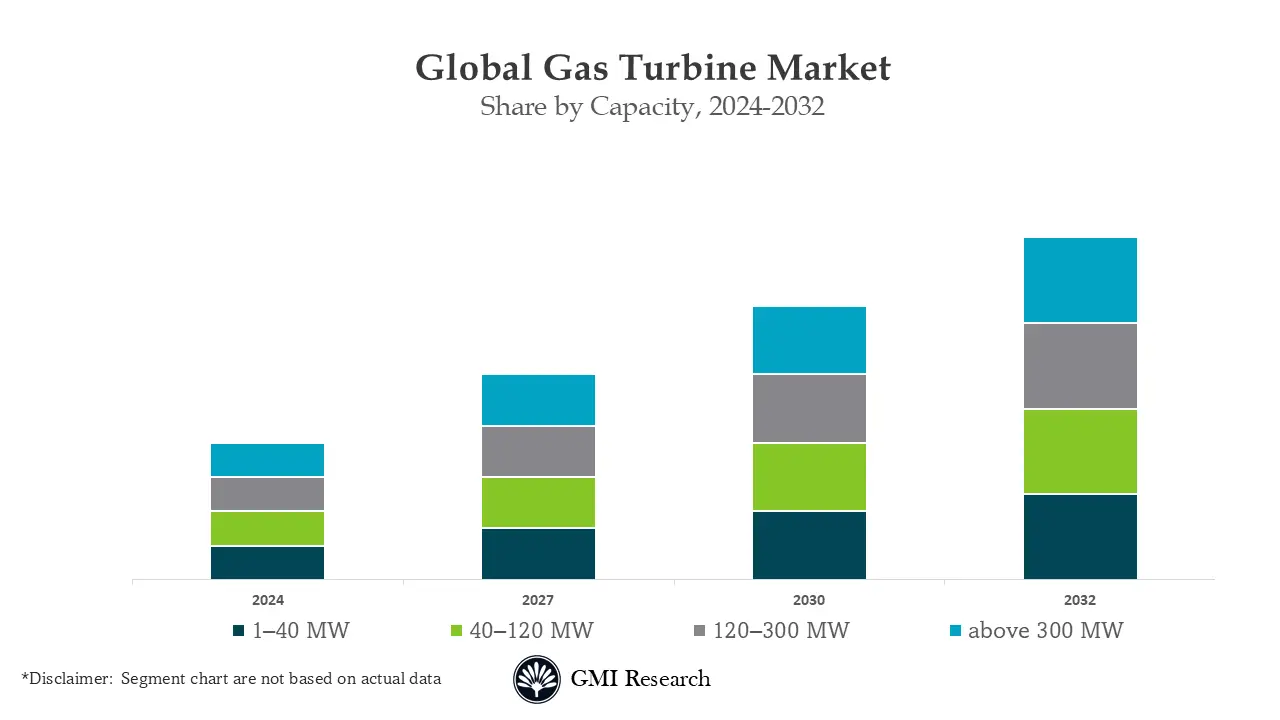
Capacity Type Insights: 100 to <150 MW is expected to dominate the market over the forecast period.
Based on capacity, 100 to <150 MW is expected to dominate the market over the forecast period. The strong demand for this type of gas turbines, especially by the power & utility companies to set up large-scale gas-based power plants in order to meet the increasing power demand from several sectors, is a key driver that is surging the growth of the market. Additionally, the shift towards gas-based power generation from coal-based methods is further driving the growth of the market.
Technology Type Insights: Combined cycle is expected to grow at a faster CAGR over the forecast period.
Based on the technology, the combined cycle is expected to grow at a faster CAGR over the forecast period. This is attributed to the technology’s ability to improve the overall efficiency of the plant. Furthermore, these turbines consumes less fuel for the production of energy. The strong demand for large capacity gas-based power plants will have a positive impact on the growth of the global gas turbine market.
End-Use Industry Type Insights: Power & Utility end industry dominated the market revenues and is predicted to lead the market share during the forecast period.
Power & Utility end industry dominated the market revenues and is predicted to lead the market share during the forecast period. One of the biggest factors that is responsible for the growth is the strong demand for large-scale power plants to meet the growing baseload power demand. The accelerating demand from the industrial and commercial sectors around the world is opening new doors for the segment’s growth
Data centre expansion has become the primary driver reshaping the global gas turbine market, marking a fundamental shift in the customer landscape as AI-driven workloads push electricity demand to unprecedented levels. According to the International Energy Agency (IEA), data centres consumed approximately 415 terawatt-hours (TWh) of electricity in 2024, accounting for around 1.5% of global electricity consumption. Over the past five years, data centre electricity demand has grown at an average annual rate of 12%, driven by rapid digitalisation and the increasing deployment of AI applications.
The rise of AI is further accelerating this trend. High-performance, AI-optimised servers require significantly greater computing power, resulting in much higher power densities within data centres and substantially increasing electricity demand.
EIA estimates that the global data centre electricity consumption is projected to more than double, reaching approximately 945 TWh by 2030, equivalent to nearly 3% of total global electricity consumption. Between 2024 and 2030, electricity demand from data centres is expected to grow at an average annual rate of 15%—more than four times faster than the growth in electricity consumption across all other sectors.
Regional Insights: Asia Pacific holds the largest market share
Asia-Pacific is expected to grow at a faster CAGR during the forecast period. China is one of the leading contributor in this regional market growth during the forecast period. in 2018, Siemens and State Power Investment Corporation (SPIC) of China joined hands to support the Chinese government to design and manufacture heavy-duty gas turbines independently. Thus, the increasing demand for gas turbines in China is a major factor that is driving the market growth. India’s power sector is dominated by coal-based generation. As per the IBEF, the Indian government is planning to achieve 227 GW capacity in renewable energy by the end of 2020. Moreover, the country’s government has identified the potential of renewable energy and gas-based generation for decarbonizing the economy and meeting the aims as per the Paris Agreement. Therefore, the rising share of gas based generation is supporting the demand for gas turbines in India. A consultation paper released by the Energy Commission indicates that Peninsular Malaysia could see up to 7,848 MW of new gas power capacity commissioned between 2029 and 2031.
Europe plans to add around 60 GW of new gas-fired power capacity, including 12 GW in Germany by 2031, of which 10 GW will comprise hydrogen-ready gas-fired plants. However, these expansion plans are expected to face extended delivery timelines due to global gas turbine supply constraints and robust demand, particularly from the U.S. Underscoring this trend, 35% of Siemens Energy’s new gas turbine orders in 2026 originated from Europe.
North America’s share of global gas turbine orders increased in 2025 compared to 2024 and is projected to significant increase during the forecast period primarily driven by rising electricity demand and the rapid expansion of power-intensive data centres. The U.S. is experiencing its strongest power demand growth in decades, driven by AI infrastructure, data centre expansion, and advanced manufacturing. Electricity consumption is expected to grow by around 2% annually over the next decade, creating significant demand for new generation capacity to support AI growth and manufacturing reshoring.
Gas Turbine Market Major Players & Competitive Landscape
Several leading companies operating in the market include GE, Siemens Energy, Mitsubishi Power, Ltd., Kawasaki Heavy Industries, Ltd., Bharat Heavy Electricals Limited, Ansaldo Energia, Solar Turbines Incorporated, OPRA Turbines, MAN Energy Solutions, and Centrax Gas Turbines.
Gas turbine manufacturers continue to face significant order backlogs as demand outpaces production capacity. GE Vernova’s current backlog comprises approximately 20% data centre projects and 80% traditional utility and industrial markets, with the mix expected to shift to 30% data centres and 70% traditional markets in the coming years.
To ease supply constraints, leading OEMs are making substantial capacity investments. GE Vernova is investing over USD 160 million to increase annual large-frame gas turbine production from around 50 units to 70–80 units by late 2026. Siemens Energy has committed USD1 billion to expand its U.S. manufacturing footprint to meet rising demand for gas turbines and grid equipment. Meanwhile, Mitsubishi Heavy Industries plans to double its large gas turbine production capacity by fiscal 2030 compared with fiscal 2024 levels, driven by rapidly growing AI-powered data centre demand. Orders for fiscal 2025 reached 35 units, a 40% year-on-year increase, while the order backlog has ballooned to 74 units.
Key Gas Turbine Market Developments
-
- In July 2026, Bharat Heavy Electricals Limited (BHEL) has won a major contract from Nigeria’s Dangote Refinery to supply eight gas turbine generator packages for its petrochemical facility. BHEL will also oversee the equipment’s erection and commissioning.
-
- In July 2026, Duke Energy has received its first advanced four new advanced gas turbines from GE Vernova, which uses combined-cycle technology to generate electricity more efficiently by converting waste heat into additional power.
Gas Turbine Market Scope of the Report
|
Report Coverage |
Details |
| Market Size Value in 2025 |
USD 22.6 Billion |
| Market Revenue Forecast in 2033 |
USD 31.1 Billion |
| CAGR |
4.1% |
| Market Base Year |
2025 |
| Market Forecast Period |
2026-2033 |
| Base Year & Forecast Units |
Revenues (USD Billion) |
| Market Segment | By Technology, By End-Use Industries, By Capacity, By Region |
| Regional Coverage | Asia Pacific, Europe, North America, and RoW |
| Companies Profiled | GE, Siemens Energy, Mitsubishi Power, Ltd., Kawasaki Heavy Industries, Ltd., Bharat Heavy Electricals Limited, Ansaldo Energia, Solar Turbines Incorporated, OPRA Turbines, MAN Energy Solutions, and Centrax Gas Turbines, among others; a total of 10 companies covered |
| 25% Free Customization Available | We will customize this report up to 25% as a free customization to address our client’s specific requirements |
Gas Turbine Market Research Report Segmentation
Global gas turbine market has been segmented on the basis of technology, end-use industries, capacity, and regions. Based on technology, the market is segmented into open cycle and combined cycle. Based on End-Use, the market is segmented into power & utility, oil & gas and other industries. Based on capacity, the market is segmented into 1-40 MW, 40-120 MW, 120-300 MW, above 300 MW.
Global Gas Turbine Market by Technology
-
- Open cycle
- Combined Cycle
Global Gas Turbine Market by End-Use Industries
-
- Power & Utility
- Oil & Gas
- Other Industries
Global Gas Turbine Market by Capacity
-
- 1-40 MW
- 40-120 MW
- 120-300 MW
- Above 300 MW
Global Gas Turbine Market by Region
-
-
North America Gas Turbine Market
- US Market
- Canada Market
-
Europe Gas Turbine Market
- UK Market
- Germany Market
- France Market
- Spain Market
- Rest of Europe Market
-
Asia-Pacific Gas Turbine Market
- China Market
- India Market
- Japan Market
- Rest of APAC Market
-
RoW Gas Turbine Market
- Brazil Market
- South Africa Market
- Saudi Arabia Market
- UAE Market
- Rest of world (remaining countries of the LAMEA region) Market
-
Gas Turbine Market Leading players
-
-
GE
-
Siemens Energy
-
Mitsubishi Power, Ltd.
-
Kawasaki Heavy Industries, Ltd.
-
Bharat Heavy Electricals Limited
-
Ansaldo Energia
-
Solar Turbines Incorporated
-
OPRA Turbines
-
MAN Energy Solutions
-
Centrax Gas Turbines
-
Frequently Asked Question About This Report
Gas Turbine Market [UP2024-001001]
According to GMI Research analyst, Gas Turbine Market size was estimated at USD 22.6 billion in 2025.
Global Gas Turbine Market growth is supported by increasing electricity demand, the shift toward more sustainable power generation, and surging power needs from expanding data centres.
GMI Research's analysis indicates that Gas Turbine Market has the potential for growth and the market size is forecast to touch USD 31.1 billion in 2033, and the market is projected to grow at a CAGR 4.1% between 2026 and 2033.
The major player dominate the market are GE, Siemens Energy, Mitsubishi Power, Ltd., Kawasaki Heavy Industries, Ltd., Bharat Heavy Electricals Limited, Ansaldo Energia, Solar Turbines Incorporated, OPRA Turbines, MAN Energy Solutions, and Centrax Gas Turbines.
Asia-Pacific is expected to grow at a faster CAGR during the forecast period. China is one of the leading contributor in this regional market growth during the forecast period
Power Generation drives the demand for gas turbines globally owing to growing demand for electricity globally. However, data centre expansion has become the primary driver reshaping the global gas turbine market.
Related Reports
Why GMI Research