
China Skincare Market and Analysis Report – Opportunities and Forecast 2026–2033
China Skincare Market Overview
China Skincare Market size valued at USD 44.2 billion in 2025 and is forecast to reach a value of USD 79.4 billion in 2033 growing at a CAGR of 7.6% between 2026 and 2033 primarily driven by driven by rising disposable incomes, increase in urbanization, growing consumer focus on appearance and skin health coupled with growing influence of social media and rapid growth of E-Commerce and social commerce.
Market Size & Forecast:
-
- 2025 – USD 44.2 Billion
- 2033 – USD 79.4 Billion
- Market Forecast – CAGR of 7.6% from 2026-2033
Key Segment Insights:
-
- Category Type Insights: facial care segment led the market in 2025, accounting for the largest revenue share.
- Concern Type Insights: Hydration and moisturizing remained the leading concern category, capturing the highest market share in 2025.
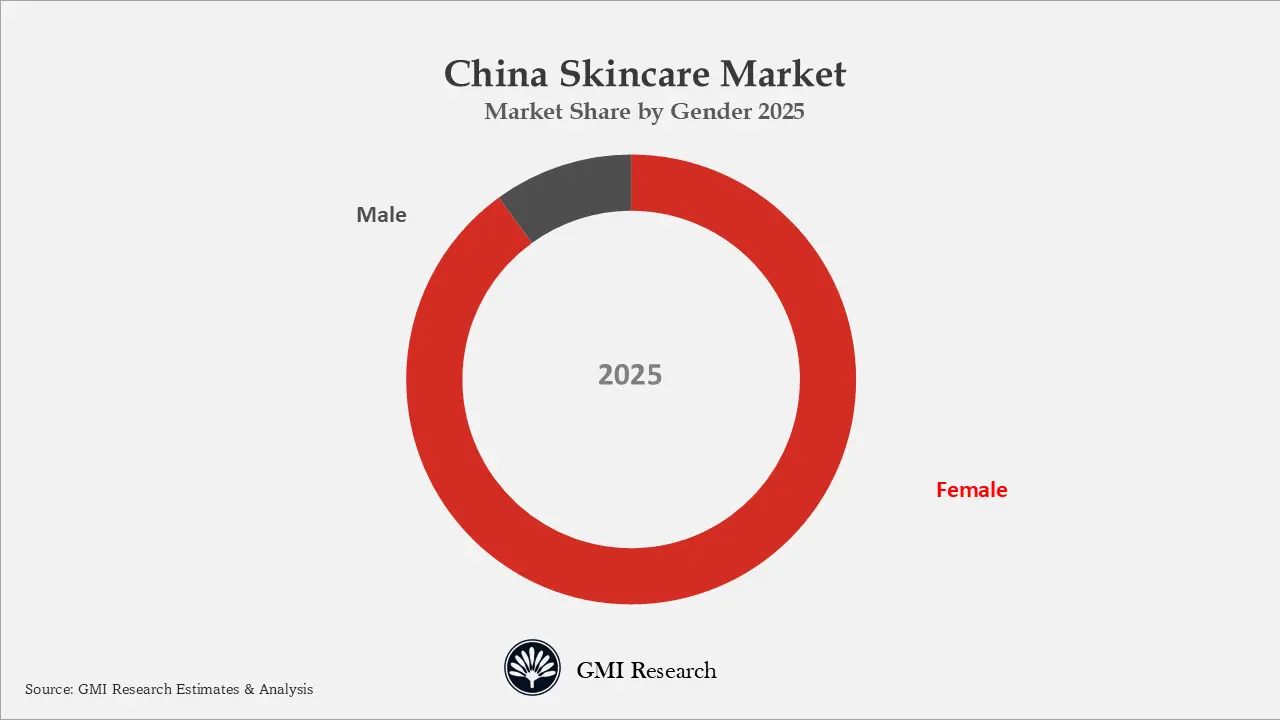
- Gender Type Insights: Female segment represented the dominant consumer group in 2025, contributing the majority of total sales.
- Distribution Channel Insights: The offline channel continued to dominate in 2025, maintaining the largest share of overall market distribution.
China Skincare Market Trends
-
- Growing demand of premium skincare products and growth of premium brands driven by rising purchasing power and increasing demand for high-performance, results-oriented products.
- Rising consumer preference for products formulated with natural and organic ingredients is significantly contributing to the market growth of skincare in China.
- Rising usage of anti-wrinkle and firming skincare products among Chinese consumers.
- Surge in the number of local cosmetic brands to address various customer requirements.
China Skincare Market Growth Drivers
Rising Disposable Incomes and Premiumization
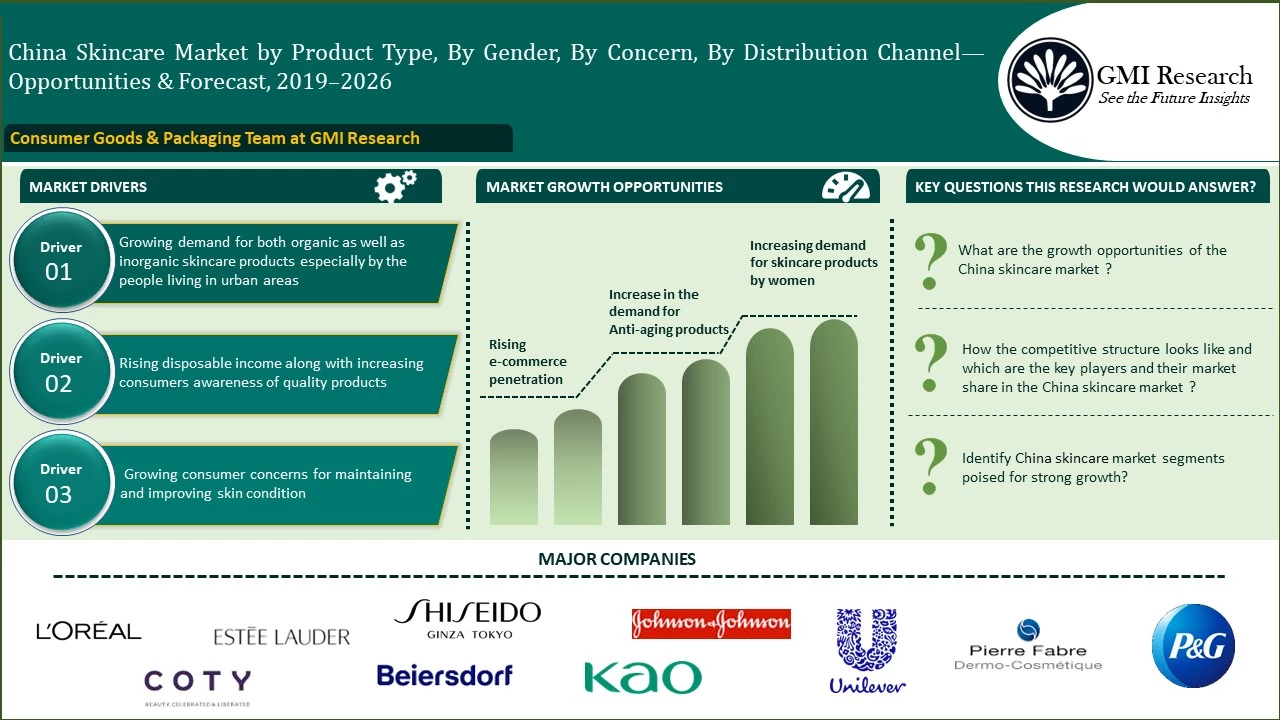
Rise in the disposable income as well as growing demand for both organic as well as inorganic Skin Care products especially by the people living in urban areas are primarily driving the growth of China Skin Care market. China is witnessing a robust growth and as per the IMF the per capita income is projected to reach around USD 19 thousand by 2030 an increase of 37% from 2025. The demand for premium cosmetic products is growing at a robust rate however because of the ongoing geopolitical crisis globally due to tariff wars creating uncertainty has slowing down the growth however during the forecast period the demand for premium cosmetic products is forecast to grow at a strong growth rate.
Strong Beauty Consciousness and Skincare Culture
Rising consumer awareness regarding the various benefits of using personal care products coupled with increasing e-commerce penetration has a positive impact on the Skin Care market. Furthermore, Chinese women are increasingly seeing Skin Care products as essentials and are the major end-users of Skin Care products. The sales volume of Skin Care products in China is witnessing considerable rise and holds substantial share of all sales in the Chinese cosmetics market.
Skin Care products support skin integrity improves the appearance and relieve skin conditions of the face and other body parts. It helps in improving the appearance and texture of the skin and also protects from the effects of pollutants, sun and other problems that have a negative impact on skin. Skin Care products are becoming popular because of various concerns includes skin brightening, anti-aging, sun protection and others and a wide range of product availability in the market.
Growing Influence of Social Media
In China the number of social media user is growing and crossing 1 billion users and it is projected to grow during the forecast period. China’s social media platforms are evolving at a rapid pace, emerging as critical channels that significantly influence consumer information discovery and purchasing decisions. Compared to west the China social media is dominated by Chinese companies such as Douyin, Xiaohongshu, and Kuaishou as internation social media platforms such as Facebook, Instagram etc. These social media platforms in China are deeply integrated with e-commerce and livestreaming features, creating distinctive opportunities for cosmetic companies to effectively connect with and engage Chinese consumers. China is one of the highest developed digital ecosystem globally and cconsumer are using social media to research product ingredients, safety, efficacy and get expert advice and influencer reviews which strongly influence the consumers to make purchase decision.
Rapid Growth of E-Commerce and Social Commerce
China is the largest e-commerce market globally and also has become one of the world’s most advanced e-commerce markets due to its huge population of over 1.4 billion. Rapid urbanization and a rising middle class have accelerated digital adoption, fostering strong demand for online goods and services and significantly driving the expansion of the country’s online retail sector especially driving cosmetic sales as e-commerce lower distribution constraints, speed up product visibility, and facilitate swift expansion for both local and global brands.
Skincare Market in China Segment Analysis
Category Type Market Insights: Facial care category dominated the market with the largest market share in 2025
Facial Care accounted for the largest market share in 2025 as increasing consumers concern on facial appearance, in order to improve facial appearance consumers are following multi-step routines using several daily products. High demand for targeted treatments addressing acne, pigmentation, aging, and hydration further expands the category.
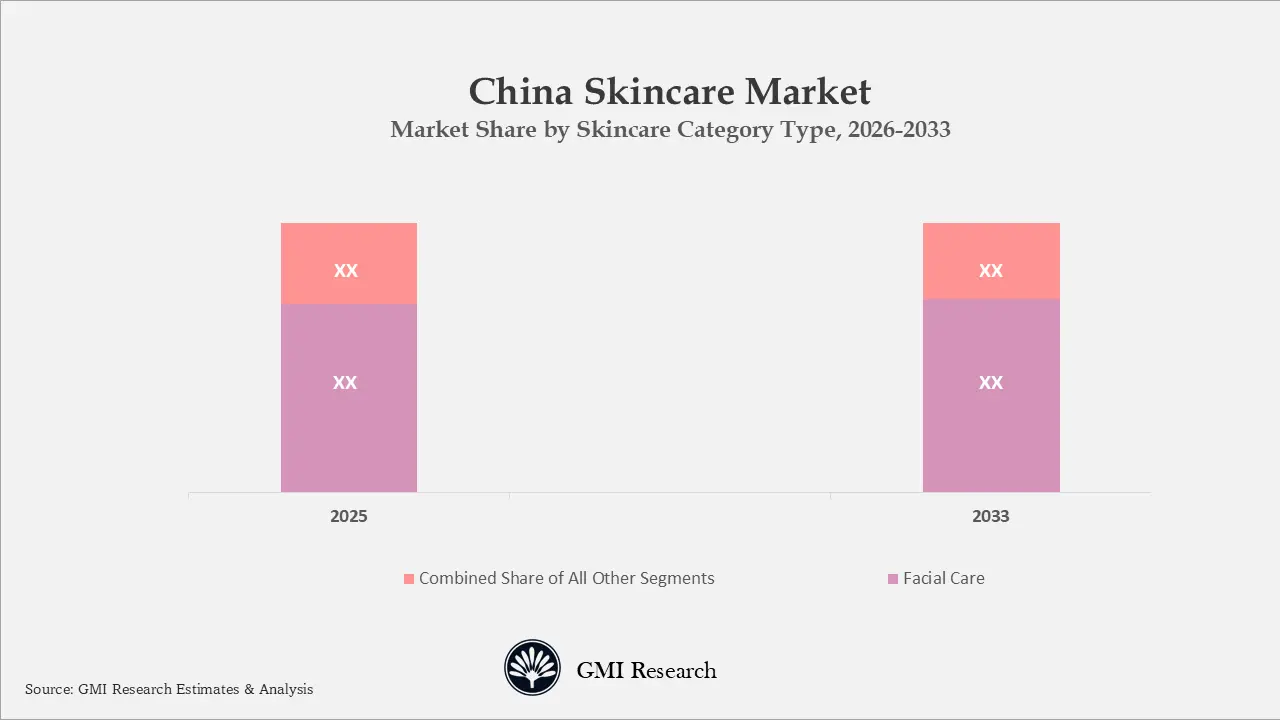
As China’s economy is growing and per capita income growing, skincare demand has shifted from basic cleansing and moisturizing to diversified, specialized solutions. Consumers now seek added benefits such as anti-aging and repair, and this evolving preference for higher-value products continues to drive strong market growth.
Concern Type Market Insights: Hydration/Moisturizing captures the largest market share in 2025.
Hydration and moisturizing products segment is expected to dominate the market throughout the forecast period due to the increase in demand for moisturizing cream which contains special ingredients that help to protect against the loss of moisture from the skin. Moreover, the continuous rise in demand for anti-aging cream, skin brightening cream, and sun protection cream among consumers will further propel the growth of the market during the forecast period. The demand for anti-aging skincare products is on the rise due to surge in demand especially the urban population. These creams as well treatments are capable of renewing skin elasticity, reducing the puffiness, firming the skin, and restore radiance from anti-aging treatments. Also, the demand for anti-aging Skin Care products is increasing in the country because of the aging fears among young population. Anti-wrinkle and firming products comprises of a major chunk of premium skincare segment sales, which focuses on superior ingredients, innovative formulations, high-performance solutions, and an elevated luxury experience.
Gender Market Insights: Female segment accounted for the maximum share in 2025
Female segment accounted for the maximum share in 2025 due to the rising adoption of Skin Care products as a daily regimen by them. The females are now more focussed towards their well-being and have high purchasing power coupled with greater cultural importance placed on beauty, frequent product use, and targeted brand offerings drive strong demand. Women often adopt multi-step skincare routines and allocate higher spending toward premium and functional products, thus propelling the growth of the segment.
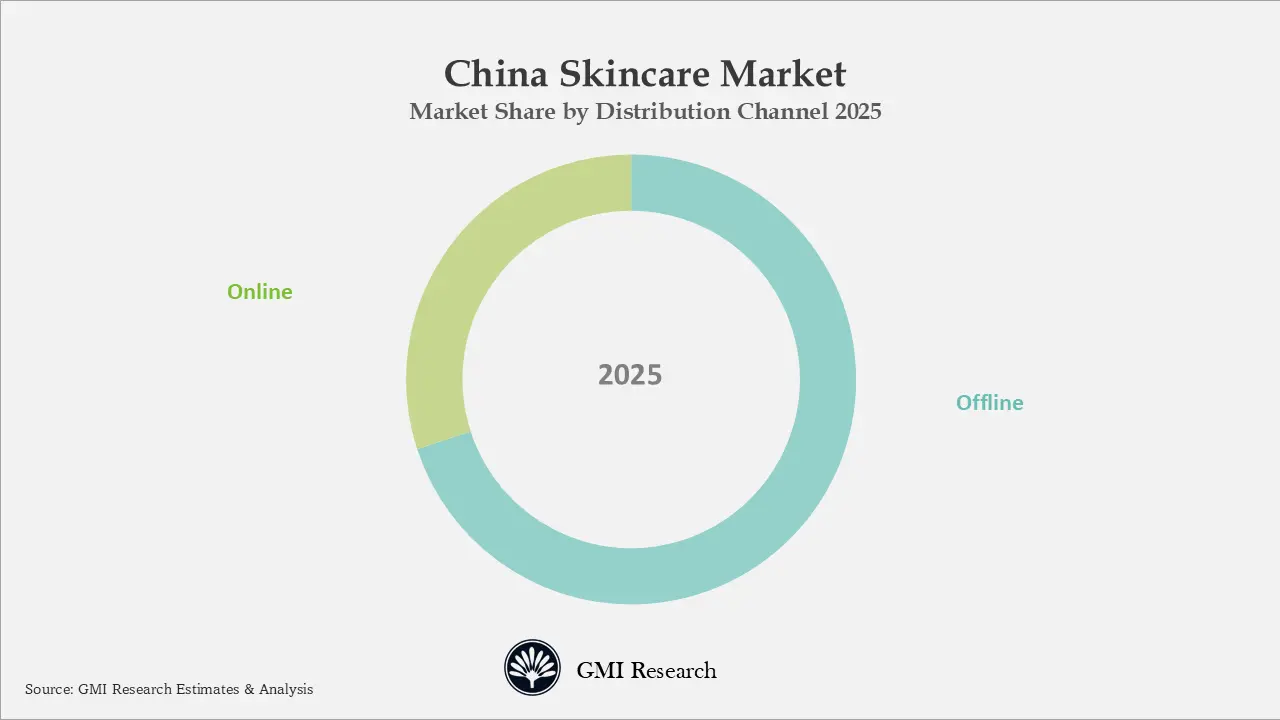
Distribution Channel Market Insights: Offline sales channel dominated the market share in 2025.
Offline sales which includes supermarkets/hypermarkets, specialized stores and others hold the largest market share in 2025 of the total skincare sales in China as physical stores provide customer experience such as touch, trial, and trust. Specialised Stores promotes brand image, ensure standardized prices and ensure the quality of services. China has a vast network of retail stores across across large, mid-tier cities and small cities supporting company in accessing large customer base driving demand for skincare products across the country.
However online channels continue to grow rapidly driven by the widespread adoption of e-commerce platforms as these online platforms provides larges variety of products to choose from with great convenience. Moreover, online platforms increases transparency and strengthen consumer engagement through reviews and interactive features, shaping purchasing decisions and building long-term brand loyalty.
China Skincare Market Major Players & Competitive Landscape
Several leading operating in China Skincare market are L’Oreal, Estée Lauder, Procter & Gamble, Shiseido, Proya Cosmetics, Shanghai Pehchaolin Daily Chemical, LVMH Moët Hennessy Louis Vuitton SA, Kunming Botanee Bio Tech, Shanghai Chicmax Cosmetics, AmorePacific Cosmetics and many more.
China skincare is highly fragmented with hundreds of brand competing for market share, big international brands have a huge presence in China and the domestic brands are also launching products on a regular basis to capture market share. However premium skincare market in China is moderately concentrated with the top skincare brands in China have captured significant market share.
Key China Skincare Market Developments
-
- In Oct 2025, Beauty Farm Medical and Health Industry Inc. has acquired 100% of Shanghai Siyanli Industrial Co., Ltd. for RMB1.25 billion. Founded in 1996, Siyanli is a leading premium beauty service brand, ranked third in China by revenue in 2024. Siyanli primarily serves urban women seeking a premium lifestyle. Following the acquisition, around 60,000 active members will be integrated into Beauty Farm’s system, increasing direct-store active membership by over 44%. The deal strengthens high-quality customer traffic and reinforces the company’s “dual beauty + dual wellness” strategy and core business foundation.
- In 2024, Beauty Farm Medical and Health Industry Inc. a leading beauty and wellness service provider in China, has acquired a 70% stake in Naturade Health Consulting Co., Ltd. for RMB 350 million. The deal includes 80 beauty and wellness stores, six aesthetic medical clinics, and two Chinese medicine outpatient clinics, marking 2024’s largest beauty industry acquisition.
- In May 2019, L’Oreal S.A. and Alibaba introduced artificial intelligence powdered mobile testing application for acne. Through this application, consumers can better understand their skin issues and also find Skin Care solutions conveniently and effectively.
- In April 2019, Shiseido Company Limited collaborated with Alibaba to provide its products in China market. Through this collaboration, Shiseido company limited will expand its position in the market.
- In January 2019, L’Oreal S.A. launched Canadian CeraVe Skin Care products to cater to the growing demand from consumers in China. The company planned to sell these products through Tmall store.
- In January 2019, Unilever acquired a Skin Care business from Lenor to expand its presence in Japan and China Market.
- In May 2018, Beiersdorf AG entered into a strategic partnership with NetEase Kaola to expand its e-commerce presence in China. Through this strategic partnership, Beiersdorf AG entered into the market through its NIVEA brand.
China Skincare Market Outlook
The future of skincare market in China looks very promising owing to growth in demand for skincare products, GMI Research expects skincare demand in China is projected to grow at a compound annual growth rate (CAGR) of over 7.6% in the coming years. In 2025, the market size was worth USD 44.2 billion, with the market size set to crack the USD 79.4 billion barrier by 2033.
China Skincare Market Scope of the Report
|
Report Coverage |
Details |
| Market Size Value in 2025 |
USD 44.2 billion |
| Market Revenue Forecast in 2033 |
USD 79.4 billion |
| CAGR |
7.6% |
| Market Base Year |
2025 |
| Market Forecast Period |
2026-2033 |
| Base Year & Forecast Units |
Revenues (USD Billion) |
| Market Segment | By Category, By Concern, By Gender, By Distribution Channel |
| Regional Coverage | China |
| Companies Profiled | L’Oreal, Estée Lauder, Procter & Gamble, Shiseido, Proya Cosmetics, Shanghai Pehchaolin Daily Chemical, LVMH Moët Hennessy Louis Vuitton SA, Kunming Botanee Bio Tech, Shanghai Chicmax Cosmetics, AmorePacific Cosmetics among others; a total of 10 companies covered. |
| 25% Free Customization Available | We will customize this report up to 25% as a free customization to address our client’s specific requirements |
China Skincare Market Research Report Segmentation
The China Skincare Market has been segmented on the basis of Category, Concern, Gender, and Distribution Channel. Based on Category, the market is segmented into Facial Care, Body Care, Hand Care, and Others. Based on Concern, the market is segmented into Hydration/Moisturizing, Anti-aging, Skin Brightening, Acne Treatments, Sun Protection, and Others. Based on Gender, the market is segmented into Female and Male. Based on Distribution Channel, the market is segmented into Offline and Online. The Offline segment is further segmented into Supermarkets, Specialized Stores, and Others.
China Skin Care Market by Category
-
- Facial Care
- Body Care
- Hand Care
- Others
China Skin Care Market by Concern
-
- Hydration/Moisturizing
- Anti-aging
- Skin Brightening
- Acne Treatments
- Sun Protection
- Others
China Skin Care Market by Gender
-
- Female
- Male
China Skin Care Market by Distribution Channel
-
- Offline
- Supermarkets
- Specialized Stores
- Others
- Online
- Offline
China Skin Care Leading market players
-
-
L’Oreal
-
Estée Lauder
-
Procter & Gamble
-
Shiseido
-
Proya Cosmetics
-
Shanghai Pehchaolin Daily Chemical
-
LVMH Moët Hennessy Louis Vuitton SA
-
Kunming Botanee Bio Tech
-
Shanghai Chicmax Cosmetics
-
AmorePacific Cosmetics
-
Frequently Asked Question About This Report
China Skin Care Market [UP180A-00-1219]
China Skincare Market size was estimated at USD 44.2 billion in 2025
Skincare market in China is fueled by rising disposable incomes and accelerating urbanization, the market is further supported by increasing consumer emphasis on appearance and skin health, alongside the expanding influence of social media and the rapid growth of e-commerce and social commerce platforms.
China Skincare Market has huge growth potential and the market size is forecast to reach a value of USD 79.4 billion in 2033 growing at a CAGR of 7.6% between 2026 and 2033.
Facial care segment led the market in 2025, accounting for the largest revenue share.
The offline channel continued to dominate in 2025, maintaining the largest share of overall market distribution. However online channel is projected to grow at the fastest rate during the forecast period.
Major players operating in the Chinese skincare market are L'Oreal, Estée Lauder, Procter & Gamble, Shiseido, Proya Cosmetics, Shanghai Pehchaolin Daily Chemical, LVMH Moët Hennessy Louis Vuitton SA, Kunming Botanee Bio Tech, Shanghai Chicmax Cosmetics, AmorePacific Cosmetics and many more.
Female segment represented the dominant consumer group in 2025, contributing the majority of total sales.
Hydration and moisturizing remained the leading concern category, capturing the highest market share in 2025.
Related Reports
Why GMI Research