
Brazil Cosmetic Market Size, Growth, Trends and Analysis Report – Opportunities and Forecast 2025-2032
Brazil Cosmetic Market Size
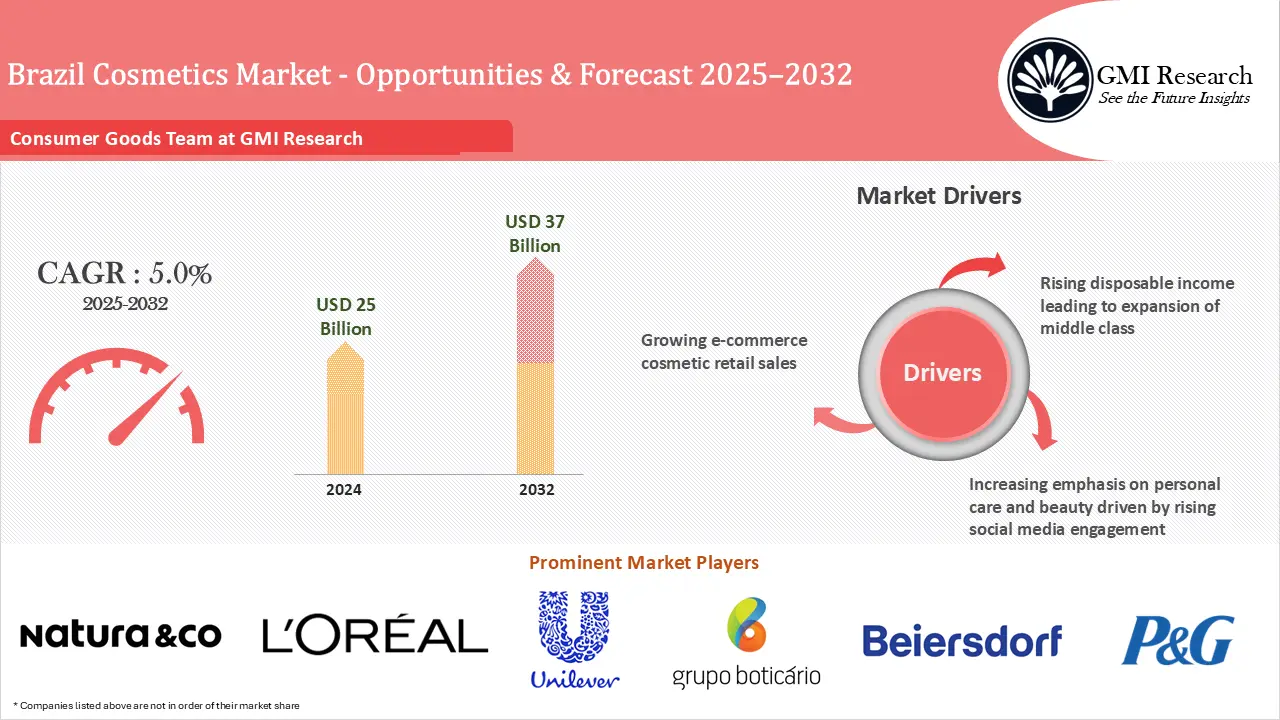
Brazil Cosmetic Market size reached USD 25 billion in 2024 and it is projected to reach USD 37 billion in 2032, the market is forecast to grow at steady CAGR of 5.0% from 2025-2032 primarily driven by growing rising disposable income leading to expansion of middle class, increasing emphasis on personal care and beauty driven by rising social media engagement, growing e-commerce cosmetic retail sales, and growing demand for more natural and sustainable products.
Key Market Forecast & Insights
Market Size:
-
- 2024 – USD 25 Billion
- 2032 – USD 37 Billion
- Market Forecast – CAGR of 5.0% from 2025-2032
Segment Insights
-
- Cosmetic Product Type Insights: Deodorants & Fragrances segment dominates the Brazil cosmetic market with a market share of 45% in 2024
- Distribution Channel Type Insights: Traditional channels still dominates the overall cosmetic retail sales in 2024 however online cosmetic retail sales are growing at faster growth rate
Brazil Cosmetic Market Growth Drivers
The cosmetic market of Brazil growth is projected to be fostered by several factors including population growth, rising income, and changes in consumer habits. Beauty holds significant importance in the country where grooming and cosmetics have become crucial aspects of everyday routine. These beauty rituals extend to all socioeconomic classes and engage the entire population. The Brazilian Association of Beauty and Hygiene states that 98 percent of Brazilians who live in favelas which are low-income areas also practice daily beauty routines.
Rising Disposable Income Leading to Expansion of Middle Class
Rising income levels in Brazil are playing a significant role in shaping consumer behavior and supporting market expansion of cosmetic market. As household earnings improve, more consumers are shifting toward higher-value products, premium brands, and discretionary spending categories such as beauty and personal care.
The growing middle class is also contributing to increased demand for modern lifestyle-oriented offerings such as cosmetics as consumer gives more emphasis on looks. Improved access to credit and financial inclusion initiatives have further strengthened purchasing power.
Increasing Emphasis on Personal Care and Beauty Driven by Rising Social Media Engagement
Brazil has one of the mobile penetration globally stood at around over 216 million which is over 102% of the total population. The country also has a very high internet penetration and social media users of around 68% of the total population. Social media has become a key channel for discovering cosmetics brands, helping companies build trust and effectively market their products to consumers, frequent posting, selfies, and video content make people more conscious of their looks, platforms such as Instagram, TikTok, and YouTube amplify beauty influencers and makeup artists who showcase their skin care routines, do product reviews and give recommendations, and show transformations and able to strongly influence purchasing decisions of end users driving demand for skincare, makeup, and grooming products in Brazil.
Growing E-Commerce Cosmetic Retail Sales
Growing trend of online shopping has greatly favored the e-commerce sector as more consumers choose to purchase beauty products through online platforms. A key factor driving people to purchase products online is to access a broader range of brands and items as certain products are unavailable in physical stores which makes them only available for purchase online or by shopping through international channels. Social media including Instagram are the primary channels for beauty consumption. Influencers have established themselves as important voices in promoting products and building brand loyalty within a large consumer base.
Why Purchase a Standard Report When You Can Customize this Report
Please Let us know your Customization Requirements
Growing Demand for More Natural and Sustainable products
The global movement towards organic products is becoming more significant in Brazil as consumers increasingly look for items made with natural ingredients and are also cruelty-free. Consumers are ready to spend more on items that are organic and promise to enhance their skin naturally. Additional factors driving its popularity include an aging population, a rising millennial demographic, and increased recognition regarding the benefits of organic products. To meet this demand, both local and international companies have altered their formulations to integrate vegan ingredients.
Customers are also increasingly mindful of animal rights and are seeking out cruelty-free cosmetics in which brands are meeting this demand by providing products that are not subject to animal testing. In the Brazil cosmetic market analysis report it is also observed that some consumers are increasingly seeking budget-friendly products that provide various advantages for skin and hair including whitening and moisturizing benefits, all at prices that are more economical than premium alternatives.
Challenges Faced by Brazil Cosmetic Market Companies
Brazil Cosmetic Market Segment Analysis
Cosmetic Market by Product Type Insights: Deodorants & Fragrances segment dominates the Brazil cosmetic market with a market share of 45% in 2024.
Deodorants & Fragrances segment dominates the Brazil cosmetic market with a market share of 45% in 2024 owing to as Brazil is the world’s second-largest fragrance market, supported by strong cultural traditions, a tropical climate, favorable economic factors, and continuous industry innovation. Fragrance carries strong cultural significance in Brazil. High standards of personal care and hygiene are widely embraced across all backgrounds, and wearing perfume is viewed as an essential part of daily grooming.
Brazil’s skincare market is expected to continue steady growth, driven by rising engagement from younger consumers in facial care and an ageing population that increases demand for extended care products. It can be attributed to its unique position within several key trends including the increasing need for self-care and health-oriented products along with the growing interest in skincare routines. Social media also plays a vital role in quickly empowering and informing consumers. There are also new technologies that help to simplify the complex options available to customers engaging with skincare brands.
There is a growing trend among Brazilian consumers to seek out effective skincare products that address various skin concerns including anti-aging and sun protection. The ability to accommodate various concerns and skin types which align with consumers’ goals for better skin health and overall wellness is fueling this segment growth. In addition, the incorporation of dermatologist-supported products along with science-based marketing strategies can enhance credibility which is attracting consumers who value solutions based on evidence. Body care products sub segment are forecast to dominate the overall skin care market and is projected to grow at a robust growth rate during the forecast period.
The makeup segment is also witnessing significant growth driven by the daily use of these products for corrective applications. Makeup items are increasingly utilized to conceal imperfections including dark circles and inflammation which help users achieve a cleaner appearance.
Distribution Channel Market Insights: Traditional channels still dominates the overall cosmetic retail sales in 2024 however online cosmetic retail sales are growing at faster growth rate
Traditional channels still dominates the overall cosmetic retail sales in 2024 however online cosmetic retail sales are growing at faster growth rate. Groceries and direct sales channel dominates the offline retails sales in Brazil. Hypermarkets and supermarkets are key retail channels in the segment that enhance convenience and accessibility for consumers seeking a broad range of beauty items in one place. With a widespread network throughout the country they provide a platform for established and new brands to display their products to a large and varied customer base. Having these products displayed on shelves boosts consumer exposure and stimulates spontaneous purchases. Moreover, the presence of promotions and discounts in these retail settings provides additional incentives for consumers. By ensuring a convenient shopping experience and addressing the needs of price-sensitive consumers, the offline segment greatly influences market expansion.
Nonetheless, the online channel is experiencing significant growth with platforms like Mercado Livre and Americanas are favored by Brazilians for their online shopping needs. These online marketplaces successfully attract millions of consumers with their marketing initiatives and targeted advertising which facilitates the beauty product sales.
Brazil Cosmetic Market Major Players & Competitive Landscape
Several leading companies are Natura & Co., Unilever, L‘Oreal, Grupo Boticário, Beiersdorf AG, and Procter & Gamble, Coty, Skala Cosméticos etc.
As per Anvisa (Brazilian Health Regulatory Agency), in Brazil there are more than 3,130 active personal hygiene, perfumery, and cosmetics (HPPC) companies. The cosmetics industry is extremely oversaturated, offering consumers an overwhelming variety of products. This intense competition makes it difficult for new brands to gain visibility without support from major global companies. Companies continuously launch new products to address diverse skin concerns and customer needs, intensifying the competition further.
Brazil Cosmetic Market News
-
- In June 2025, Brazilian beauty brands Skala and Lola From Rio have merged to form one of the country’s largest beauty groups, generating about R$2 billion in combined revenue and reaching 54% of Brazilian households with sales in over 80 countries. The two brands, known for their vegan and conscious beauty positioning, bring complementary product portfolios and strong consumer loyalty, with more than seven million social media followers. While they will maintain independent operations across Rio de Janeiro, Uberaba, and São Paulo, they will integrate manufacturing, distribution, and innovation efforts to accelerate growth domestically and internationally.
Brazil Cosmetic Market Scope of the Report
|
Report Coverage |
Details |
| Market Size Value in 2024 |
USD 25 billion |
| Market Revenue Forecast in 2032 |
USD 37 billion |
| CAGR |
5.0% |
| Market Base Year |
2024 |
| Market Forecast Period |
2025-2032 |
| Base Year & Forecast Units |
Revenues (USD Million) |
| Market Segment | By Product, By Distribution Channel |
| Regional Coverage | Brazil |
| Companies Profiled | Natura & Co., Unilever, L‘Oreal, Grupo Boticário, Beiersdorf AG, and Procter & Gamble, Coty, Skala Cosméticos , among others; a total of 10 companies covered. |
| 25% Free Customization Available | We will customize this report up to 25% as a free customization to address our client’s specific requirements |
Brazil Cosmetic Market Research Report Segmentation
The Brazil Cosmetic Market has been segmented on the basis of product and distribution channel. Based on the product, the market is segmented into skin care, hair care, makeup, fragrance, others. Based on the distribution channel, the market is segmented into offline, online.
Brazil Cosmetic Market by Product
-
- Skin Care
- Hair Care
- Makeup
- Fragrance
- Others
Brazil Cosmetic Market by Distribution Channel
-
- Supermarkets/Hypermarkets
Direct Selling - Pharmacies
- Beauty Specialist
- Others
- Supermarkets/Hypermarkets
Brazil Cosmetic Market Leading players
-
- Natura & Co.
- Unilever
- L’Oréal
- Grupo Boticário
- Beiersdorf AG
- Procter & Gamble
- Coty
- Skala Cosméticos
Frequently Asked Question About This Report
Brazil Cosmetic Market [GR24AB-01-00341]
Brazil Cosmetic Market size was estimated at USD 25 billion in 2024.
Brazil Cosmetic Market growth is primarily driven by growing rising disposable income leading to expansion of middle class, increasing emphasis on personal care and beauty driven by rising social media engagement, growing e-commerce cosmetic retail sales, and growing demand for more natural and sustainable products.
Brazil Cosmetic Market looks promising, the market is forecast to grow at steady CAGR of 5.0% from 2025-2032.
Major players are operating in the market are Natura & Co., Unilever, L‘Oreal, Grupo Boticário, Beiersdorf AG, and Procter & Gamble, Coty, Skala Cosméticos etc.
Deodorants & Fragrances segment dominates the Brazil cosmetic market with a market share of 45% in 2024.
Traditional channels still dominates the overall cosmetic retail sales in 2024, in Offline segment, groceries and direct sales channel dominates the offline retails sales in Brazil.
Related Reports
Why GMI Research